


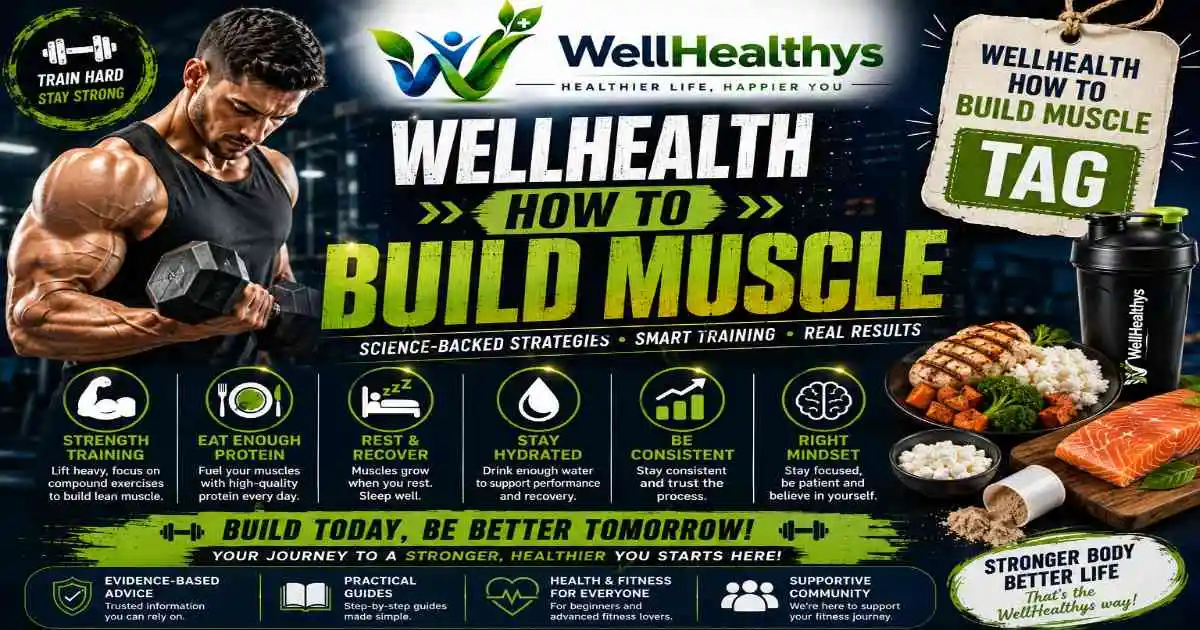
Two kinds of people usually land here. Someone who has never touched a weight and has no idea where to start, or someone who has been in the gym for months with barely anything to show for it. Different starting points, same root problem: nobody handed either of them a clear, honest plan.
That’s what this wellhealth how to build muscle tag guide is. WellHealthys built this as a complete resource, not a rehash of the same five bullet points you’ve already read on ten other sites. We’re going to walk through a beginner workout routine, a full muscle building diet plan, recovery, and the mistakes that quietly stall progress for almost every beginner.
One quick note before we start. If you’re 16 or 17, strength training is safe and effective when the focus is on form and consistent technique rather than chasing the heaviest weight in the room. If you’re newer to lifting at any age, that same advice applies to you too. Muscle is built with patience, not ego.
Who This Guide Is For
This article is written for:
- Complete beginners who’ve never set foot in a gym
- People who train at home and don’t own a barbell
- Bodybuilding enthusiasts looking to sharpen their approach
- Anyone trying to gain lean muscle without gaining a lot of fat
- People who want to build muscle naturally, without supplements or shortcuts
- Beginners who need both a workout plan and a diet plan, because one without the other doesn’t work
If that’s you, keep reading. Everything below is built to be usable today, not just theory.
The 3 Pillars of Muscle Building: The WellHealthys Method
Muscle growth comes down to three things working together. Skip one and the other two stop mattering as much.
Training. Your muscles grow when you challenge them with more resistance than they’re used to, over time. This is called progressive overload. It doesn’t mean lifting heavier every single session. It means your body should rarely be doing the exact same workout, at the exact same difficulty, week after week.
Nutrition. You can train perfectly and still not grow if you’re not eating enough protein and enough total calories. Muscle tissue is literally built from the protein you eat. No surplus of building material, no new muscle.
Recovery. Muscle doesn’t grow in the gym. It grows while you sleep and rest. The workout is the signal. Recovery is when your body actually does the building.
We call this the WellHealthys Method because it’s the same framework we come back to in every training and nutrition article on this site. Once you understand these three pieces, the rest of this guide is just the details of how to apply them.
Beginner Workout Plan to Build Muscle (Gym Version)

If you’re new to lifting, you don’t need a five-day split with 20 exercises. A good beginner workout routine is built around compound movements, exercises that work multiple muscle groups at once and give you the most result for your time. You’ll find more structured plans like this one in the WellHealthys workouts section as you progress.
A solid 4-day beginner structure looks like this:
Day 1: Upper Body Push Bench press, shoulder press, tricep pushdowns. These push muscles away from your body and hit your chest, shoulders, and triceps.
Day 2: Lower Body Squats, leg press, calf raises. Squats alone work your quads, glutes, hamstrings, and core.
Day 3: Upper Body Pull Rows, lat pulldowns, bicep curls. These pull weight toward your body and target your back and biceps.
Day 4: Full Body or Deadlift Focus Deadlifts, lunges, planks. Deadlifts are one of the best overall muscle builders you can do, because they recruit almost your entire body.
For sets and reps as a beginner, aim for 3 sets of 8 to 12 reps per exercise. Pick a weight where the last 2 reps of each set feel genuinely hard, but your form doesn’t break down.
Here’s something most guides skip: your first month is going to feel rough. You’ll be sore in places you didn’t know could get sore. Your numbers will jump quickly at first, not because you’re building huge amounts of muscle already, but because your nervous system is learning the movements. That’s normal. Stick with it past week 3 or 4, and that’s when real, visible progress starts showing up.
How to Build Muscle at Home Without Equipment
Not having a gym membership isn’t an excuse, it’s just a different set of tools. Bodyweight training can absolutely build muscle, especially for beginners.
A simple 3-4 day home routine:
Push movements: Push-ups (regular, incline, or knee variations depending on your level), pike push-ups for shoulders, dips using a chair or sturdy table.
Pull movements: Doorframe pull-ups if you can rig a bar, or resistance band rows if you have a band. A loaded backpack can substitute for a barbell in rows if you bend over a chair.
Legs: Squats, lunges, single-leg glute bridges, calf raises. Add a backpack loaded with books once bodyweight squats get easy.
Core: Planks, side planks, leg raises.
The challenge with home training is progression, since you can’t just add plates to a bar. Here’s how you progress instead: increase reps, slow down the tempo (a 4-second lower on a push-up is much harder than a fast one), reduce rest between sets, or move to a single-limb version of the exercise (single-leg squats are dramatically harder than two-leg squats). Once regular push-ups feel easy for 20+ reps, that’s your signal to add difficulty, not just do more of the same.
Muscle-Building Diet Plan (Including Vegetarian Options)

This is where most people quietly fail. You can have the best workout program in the world and still not build muscle if your plate doesn’t match your effort. A proper muscle building diet plan matters just as much as your training split, and it doesn’t have to be complicated. For more meal ideas, browse the WellHealthys Nutrition & Diet section.
Protein target: Aim for 1.6 to 2.2 grams of protein per kilogram of bodyweight per day. So if you weigh 70 kg, that’s roughly 112 to 154 grams of protein daily. That sounds like a lot until you break it down across meals. Three meals with 30-35 grams of protein each, plus a snack, gets you there without much strain.
Vegetarian protein sources (genuinely useful for Indian diets, since most guides only talk about chicken and eggs): paneer, tofu, soy chunks, moong dal, chana, rajma, sattu, Greek yogurt, milk, and whey protein if you want a supplement. A bowl of dal with rice, a glass of milk, and a serving of paneer sabzi can easily add up to 40-50 grams of protein in one meal.
Non-vegetarian sources: chicken breast, eggs, fish, and lean cuts of meat. Two whole eggs plus three egg whites gives you around 25 grams of protein for roughly 220 calories.
A sample day might look like:
- Breakfast: Oats with milk and a scoop of peanut butter, or 3 eggs with toast
- Lunch: Dal, rice, a side of paneer or chicken, and vegetables
- Snack: Greek yogurt or a handful of roasted chana
- Dinner: Grilled fish or tofu stir-fry with vegetables and a small portion of rice
Carbs and fats matter too. Carbs fuel your workouts and help your body use protein more efficiently. Fats support hormone production, including testosterone, which plays a role in muscle growth. Cutting either one too aggressively while trying to build muscle usually backfires.
How Much Protein Do You Need? Quick Reference
| Body Weight | Daily Protein Range |
| 50 kg | 80-110 g |
| 60 kg | 96-132 g |
| 70 kg | 112-154 g |
| 80 kg | 128-176 g |
| 90 kg | 144-198 g |
Use this as a starting point and adjust based on how your body responds over a few weeks.
Recovery: Why Rest Days Matter As Much As Training

Here’s the part people underestimate. When you lift weights, you’re creating small amounts of damage in the muscle fibers. Your body repairs that damage during rest, and the repaired fibers come back slightly thicker and stronger than before. That’s muscle growth. If you never give your body time to repair, you’re just accumulating damage without the rebuild.
Sleep is where most of this repair happens. Aim for 7 to 9 hours a night. Cutting sleep short doesn’t just make you tired, it directly reduces muscle protein synthesis and increases the stress hormone cortisol, which works against your progress. WellHealthys covers sleep and stress management in more depth in the Wellness section if you want to go deeper on recovery.
Take at least 1 to 2 full rest days per week, and don’t train the same muscle group on back-to-back days early on. Signs you’re overtraining include constant fatigue, declining strength instead of improving, irritability, and getting sick more often than usual. If that sounds like you, an extra rest day will do more for your gains than another hard workout.
Natural Muscle-Building Tips (No Shortcuts, No Steroids)
Natural muscle growth is slower than what supplements or shortcuts promise, and a few myths are worth clearing up, because they cause a lot of unnecessary confusion.
“Protein damages your kidneys.” This is true for people with existing kidney disease, but for healthy individuals, a meta-analysis of controlled trials found no meaningful difference in kidney function between people eating higher versus normal amounts of protein.
“You need supplements to build muscle.” Supplements like whey protein are convenient, not mandatory. If you’re hitting your protein target through food, a supplement isn’t doing anything a chicken breast or bowl of dal couldn’t do.
“Cardio kills your gains.” Moderate cardio alongside strength training doesn’t erase muscle growth. It supports your heart health and recovery. The concern only becomes real with excessive, high-volume endurance training combined with inadequate eating.
Natural muscle building is slower than what you’ll see from people using performance-enhancing drugs, and that’s fine. It’s also more sustainable, healthier long-term, and honestly more satisfying because the progress is entirely yours.
Common Mistakes Beginners Make When Building Muscle
- Skipping warm-ups and going straight into heavy sets, which raises injury risk
- Chasing heavier weight before your form is solid
- Not eating enough, especially not enough protein
- Doing the exact same workout for months with no progression
- Switching programs every two weeks before giving one a real chance to work
- Ignoring sleep while still expecting gym-level results
- Comparing your week 4 progress to someone else’s year 2 physique
Most of these aren’t complicated to fix. They just require consistency over cleverness.
How Long Does It Take to Build Muscle?
For a true beginner, visible changes usually start showing up around 8 to 12 weeks of consistent training and eating. Strength gains happen faster than visible size, often within the first few weeks, because your nervous system adapts before your muscle tissue does.
As a rough guide:
- Beginners can gain around 0.5 to 1 kg of lean muscle per month under good conditions
- Intermediate lifters slow to roughly 0.25 to 0.5 kg per month
- Advanced lifters often see well under that, sometimes just a few kilograms per year
These numbers vary by genetics, sleep, diet consistency, and training quality, but they give you a realistic bar instead of the unrealistic “shredded in 30 days” promises you’ll see elsewhere.
FAQs: WellHealth How to Build Muscle Tag
Can beginners build muscle at home without gym equipment?
Yes. Bodyweight exercises like push-ups, squats, and lunges can build real muscle, especially for beginners, as long as you progressively make the exercises harder over time.
How much protein do I need daily to build muscle?
Generally 1.6 to 2.2 grams per kilogram of bodyweight. A 70 kg person should aim for roughly 112 to 154 grams per day.
Is 16 too young to start strength training?
No. Strength training is safe for teenagers when the focus is on proper form and gradual progression rather than maxing out weight.
Can I build muscle on a vegetarian diet?
Yes. Paneer, tofu, soy chunks, lentils, and dairy provide more than enough protein to support muscle growth when eaten consistently.
How long before I see visible muscle growth?
Most beginners notice visible changes around 8 to 12 weeks of consistent training and proper nutrition.
Do I need supplements to build muscle?
No. Natural muscle growth is entirely possible through food alone. Supplements are a convenience, not a requirement, if you’re already meeting your protein needs through what you eat.
Ghar par bina equipment ke muscle kaise banaye?
Push-ups, squats, lunges aur planks jaise bodyweight exercises se ghar par bhi muscle build ho sakta hai. Bas reps badhate raho ya exercise ko thoda tough karte raho, jaise single-leg squats ya slow tempo push-ups.
Muscle building ke liye roz kitna protein lena chahiye?
Body weight ke hisaab se 1.6 se 2.2 gram protein per kilogram roz lena chahiye. Agar aapka weight 70 kg hai, toh roughly 112 se 154 gram protein daily target karo.
Kya vegetarian diet se bhi muscle ban sakta hai?
Bilkul. Paneer, tofu, soya chunks, moong dal, chana aur sattu jaise sources se aasani se roz ka protein target pura ho sakta hai, non-veg ki zaroorat nahi hai.
Muscle build hone me kitna time lagta hai?
Beginners ko usually 8 se 12 hafton me visible changes dikhna shuru ho jate hain, agar training aur diet dono consistent rahe.
Kya muscle banane ke liye supplements lena zaroori hai?
Nahi. Agar aap apna protein target khaane se hi pura kar rahe ho, toh whey protein ya koi aur supplement zaroori nahi hai, sirf convenient hai.
Your Next Step with WellHealthys
You’ve got the full plan now, training, diet, and recovery, all in one place. Reading about it won’t change anything on its own.
- Pick your track: gym workout plan or home bodyweight routine, whichever fits your life right now
- Set your protein number from the table above and build one day’s meals around it
- Commit for 2 weeks without switching programs, then reassess
- Still unsure where to start? Talk to WellHealthys and we’ll point you in the right direction
About the Author
This guide was written by Prashant Kashyap, the writer behind WellHealthys, where the goal is simple: practical, no-jargon health and fitness content that people can actually use. You can read more articles like this one in the Fitness section on WellHealthys.
Disclaimer
This article is for general informational purposes only and is not a substitute for professional medical advice. Always consult a doctor or certified fitness trainer before starting a new workout or diet program, especially if you’re under 18, pregnant, or managing an existing health condition. Results vary from person to person based on genetics, consistency, and individual health factors. For our full policy, see the WellHealthys Disclaimer.
Final Thoughts
That covers the full wellhealth how to build muscle tag breakdown: training, eating, and recovering in a way that actually adds up over time. Building muscle isn’t complicated, but it does require consistency in three areas at once. Miss one of these and progress slows down no matter how hard you’re working on the other two.
Here’s your next step. Pick the plan that matches your situation, gym or home, commit to it for the next two weeks without switching things up, and pair it with the diet plan above. Track your workouts and meals somewhere, even if it’s just notes on your phone, so you can see the progress that’s easy to miss day to day.
Got a specific question about your own situation? Reach out to WellHealthys and we’ll help you figure it out.

4 Comments
Pingback: Beauty Tips - Well Health Organic.com: 7 Tips | WellHealthys
Pingback: Healthy Life WellHealthOrganic: 10 Proven Daily Habits
Pingback: Wellhealthorganic Work Life Balance: 5 Tips | WellHealthys
Pingback: Protein Rich Vegetarian Diet India: 12 High-Protein Foods