


Last updated: September 2026 | Written by Prashant Kashyap, Founder at WellHealthys
A phone that buzzes with a work message at 9 PM. A laptop that never really gets closed because “just five more minutes” turns into an hour. For a lot of working professionals in India today, work-life balance is not about finding more free time, it is about the line between work and everything else disappearing entirely.
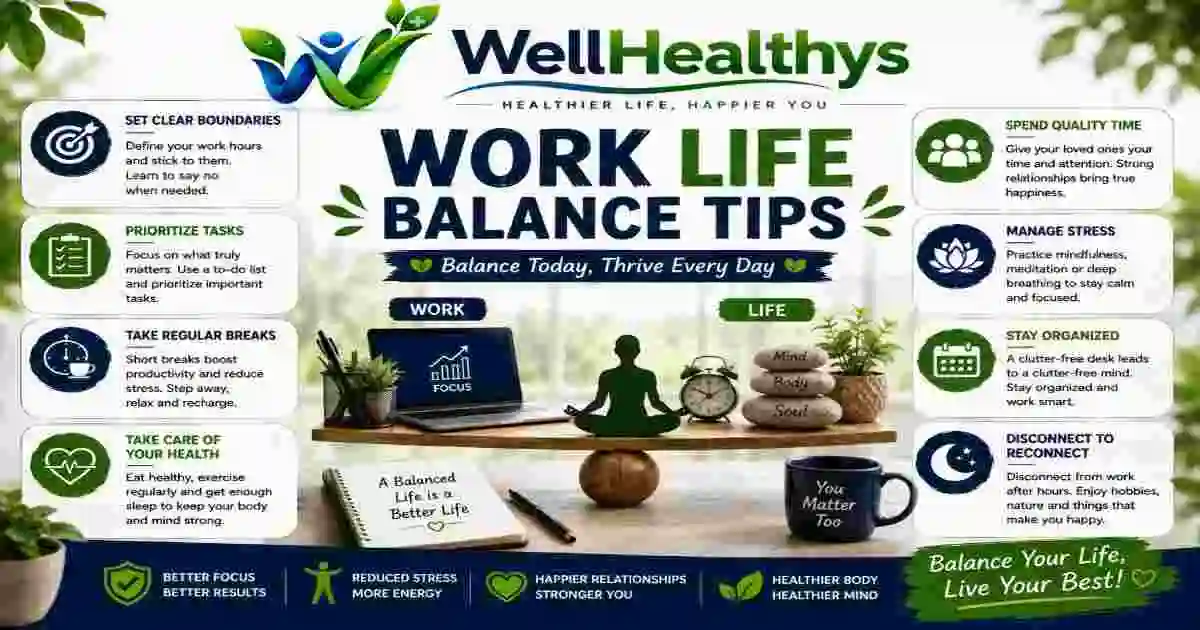
At WellHealthys, we wanted to write about wellhealthorganic work life balance tips without repeating the same generic advice you have already read a hundred times: drink water, sleep well, take breaks. Instead, this guide looks at what actually gets in the way for Indian professionals specifically, whether you work from home, from an office, in shifts, or on your own as a freelancer, and how to build boundaries that hold up in real life, not just on paper.
What Wellhealthorganic Work Life Balance Actually Means

Work-life balance does not mean splitting your day exactly 50-50 between work and personal life. Almost nobody manages that, and chasing it just adds another thing to feel bad about. A more useful way to think about it is this: can you mentally and physically step away from work when your work hours are over, without guilt, without your phone pulling you back in, and without your body still running on stress hours later?
That is really what wellhealthorganic work life balance comes down to, having a boundary that your mind actually respects, not just a schedule that says “work ends at 6 PM” while your brain keeps running spreadsheets until midnight.
Why It Feels Harder Right Now
A few things have made this genuinely harder in the last few years, not just for you, for most working professionals.
Remote and hybrid work removed the natural boundary that a commute used to create. When your office was a train ride away, leaving the office meant leaving work behind, at least physically. Now your “office” might be the same chair you eat dinner in, so your brain never gets a clear signal that the workday has ended.
Job security concerns have also made people hesitant to enforce boundaries. In a survey covered by Central Washington University’s career services team, a notable share of workers reported not having enough flexibility to maintain a healthy balance, and that pressure only grows when people worry that saying no to after-hours messages might affect how they are seen at work.
For Indian professionals specifically, there are a few added layers. Long commutes in cities like Delhi, Mumbai, and Bangalore already eat into personal time before work even starts. WhatsApp-driven office culture blurs the line between a quick work update and an actual after-hours intrusion. And joint family responsibilities often mean personal time is not fully “personal” either, it is shared with caregiving duties that don’t pause for a bad workday. Chronic work stress also shows up physically, often on your skin first, so if breakouts or dullness have crept in alongside a hectic schedule, our organic skincare guide covers routines that hold up even on your busiest weeks.
Wellhealthorganic Work Life Balance Tips by Job Type

Generic advice fails here because a work-from-home professional and a shift worker are dealing with completely different problems. Here is what actually helps, broken down by how you work.
If You Work From Home
Your biggest challenge is that work has no physical edge, which makes work from home boundaries especially hard to hold onto. Fix this by creating a small physical ritual that marks the start and end of your workday, even something as simple as changing out of your work clothes or stepping outside for five minutes when you log off. Keep your work laptop out of the room where you relax in the evening, if space allows. Physical separation does a lot of the mental work for you.
If You Work From an Office
Your challenge is usually the commute eating into your personal time twice a day. Use the commute itself as a transition ritual instead of dead time, a podcast, music, or even just quiet thinking can help your brain shift gears. Resist checking work email the moment you’re back home. Give yourself a fixed 15 to 20 minute buffer after reaching home before you engage with anything work-related. If long desk hours are also leaving you stiff and low on energy, our wellhealth how to build muscle tag guide has simple strength routines that fit around a full-time job.
If You Work Shifts
Your challenge is that your “evening” might be someone else’s afternoon, which makes it hard to protect personal time that doesn’t match everyone else’s schedule. Protect your sleep window like an appointment you cannot move, use blackout curtains and tell family members your sleep hours clearly. Build one small non-negotiable personal activity into your schedule regardless of what shift you’re on, even 20 minutes of something you enjoy keeps your identity from being fully absorbed by work.
If You Freelance or Do Gig Work
Your challenge is usually the opposite of everyone else’s, there is no natural “end” to the workday unless you create one. Set fixed working hours for yourself and communicate them to clients upfront, most clients respect this more than you’d expect. Track your hours even if no one is checking, it makes it much easier to notice when work is quietly expanding into personal time.
If irregular sleep or long hours are part of your current reality, our wellhealthorganic fitness guide has recovery-focused routines that work even on inconsistent schedules.
A Realistic Daily Boundary Schedule

Here’s what a workable boundary structure can look like for a typical 9-to-6 office job. Adjust the times to fit your actual schedule.
Before work (15 minutes): No work email or Slack first thing. Use this time for literally anything else, even just having tea without your phone.
During work hours: One genuine break away from your screen, ideally outside if possible. Even 10 minutes of daylight and movement resets your focus more than another cup of coffee does.
The transition (15 to 20 minutes): Whether it’s a commute or just closing your laptop, use this window intentionally. Don’t open work chats “just to check.”
Evening (first hour): Keep this hour work-message-free. This is the hour most people lose to “quickly replying,” and it’s the one that matters most for actually switching off.
Before bed: No work screens at least 30 minutes before sleep. Your brain needs that runway to actually wind down, not just physically stop typing.
Setting Digital Boundaries

“Set boundaries with your phone” is advice everyone gives and almost nobody explains how to actually do. Here’s the practical version of setting digital boundaries at work.
Turn off work app notifications outside your set work hours, not just email, this includes Slack, Teams, and any project management app. Most of these apps let you schedule “quiet hours” in their settings, use that feature instead of relying on willpower alone.
Use a separate profile or folder for work apps on your phone if your job allows it, so opening your phone in the evening doesn’t put work notifications directly in your line of sight.
Tell your immediate team once, clearly, what your working hours are. Most colleagues aren’t trying to intrude, they just don’t know your boundaries unless you state them.
The Guilt Problem

This is the part most work-life balance advice skips entirely, and it’s often the actual reason boundaries don’t stick, and why so many professionals quietly slide toward work-related burnout. You can know exactly what to do and still not do it, because setting a boundary feels like you’re being lazy, uncommitted, or letting your team down.
A few things help with this. Remind yourself that rested, focused work is genuinely better work, not doing less work, just doing it during hours that don’t quietly consume your entire life. Notice if the guilt is coming from an actual expectation your manager has stated, or from an assumption you’ve made about what “looks good.” Often it’s the second one.
If the guilt persists even after you’ve set reasonable boundaries and nothing bad has actually happened as a result, that’s usually a sign the boundary was fine, the guilt was just old habit catching up.
When It’s a Job Problem, Not a You Problem
Sometimes no amount of personal boundary-setting fixes the actual issue, because the workplace itself doesn’t support balance. If your role consistently requires after-hours availability as an unstated expectation, if taking your full leave is quietly discouraged, or if raising the topic with your manager gets brushed off repeatedly, that’s a structural problem, not a personal habit you can meditate your way out of.
In these cases, it’s worth having a direct, calm conversation with your manager about specific expectations, in writing if possible, so there’s clarity for both sides. If that doesn’t lead anywhere, it may be worth evaluating whether the role itself is sustainable long term.
Frequently Asked Questions About Wellhealthorganic Work Life Balance
What is wellhealthorganic work life balance?
It refers to building practical boundaries between work and personal time using routines suited to your specific job type, digital limits, and a realistic daily structure, rather than vague, one-size-fits-all advice.
How do I stop checking work messages after hours?
Turn off notifications for work apps outside your set hours using each app’s built-in quiet hours feature, and give yourself a fixed buffer time after work before you allow yourself to check anything work-related.
Is work-life balance possible in a demanding job?
It’s harder, but usually still possible with clear boundaries and honest conversations with your manager about expectations. If the role genuinely requires constant after-hours availability as an unstated norm, that’s a structural issue worth addressing directly rather than working around indefinitely.
Work life balance kaise improve karein naukri mein?
Sabse pehle apne kaam ke ghanton ko clearly define karein aur unhe apni team ko bata dein. Phone par work app notifications ko off-hours mein band rakhein, aur ghar aane ke baad kam se kam 15-20 minute ka buffer time rakhein bina kaam check kiye.
Work se disconnect karne mein guilt kyun hota hai?
Zyadatar ye guilt is wajah se hota hai kyunki humein lagta hai boundary set karna lazy ya uncommitted dikhna hai. Lekin asal mein rested hokar kaam karna better hota hai, kam kaam karna nahi. Ye check karna zaroori hai ki guilt manager ki actual expectation se aa raha hai ya sirf apni soch se.
Work from home mein boundaries kaise banayein?
Ek chhota physical ritual banayein jo workday ke start aur end ko mark kare, jaise kapde change karna ya 5 minute bahar walk karna. Agar possible ho toh work laptop ko us room se bahar rakhein jaha aap evening mein relax karte hain.
Shift work mein personal time kaise protect karein?
Apne sleep hours ko ek fixed appointment ki tarah treat karein, blackout curtains use karein aur family ko apne sleep timing clearly bata dein. Har din, chahe koi bhi shift ho, ek chhoti si personal activity zaroor rakhein jo sirf aapke liye ho. Aur roz ke general wellness habits ke liye, hamara well health tips in Hindi wala guide bhi kaam aayega.
Your Next Step
Pick just one boundary from this guide, maybe the 15-minute morning buffer, or turning off notifications after your work hours end, and try it consistently for one week before adding anything else.
- If stress is showing up physically for you, our wellhealthorganic fitness guide has recovery-focused routines that fit even a packed schedule.
- For the bigger picture on building sustainable daily habits, our healthy life wellhealthorganic guide is a good next read.
- Explore more wellness guides at WellHealthys, and subscribe for practical, no-nonsense tips.
Disclaimer
This article is for general informational and educational purposes only and is not a substitute for professional medical, psychological, or workplace advice. Everyone’s job, employer expectations, and personal circumstances are different, so adapt these suggestions to your specific situation. If work-related stress is affecting your mental health significantly, please consult a qualified mental health professional or counselor. WellHealthys is not responsible for any outcomes resulting from the use of tips shared in this article.
About the Author
Prashant Kashyap is a health and wellness content creator at WellHealthys, sharing practical tips on health, fitness, nutrition, and healthy living for real, busy schedules. His goal is to make useful wellness information simple, honest, and easy to apply.
