


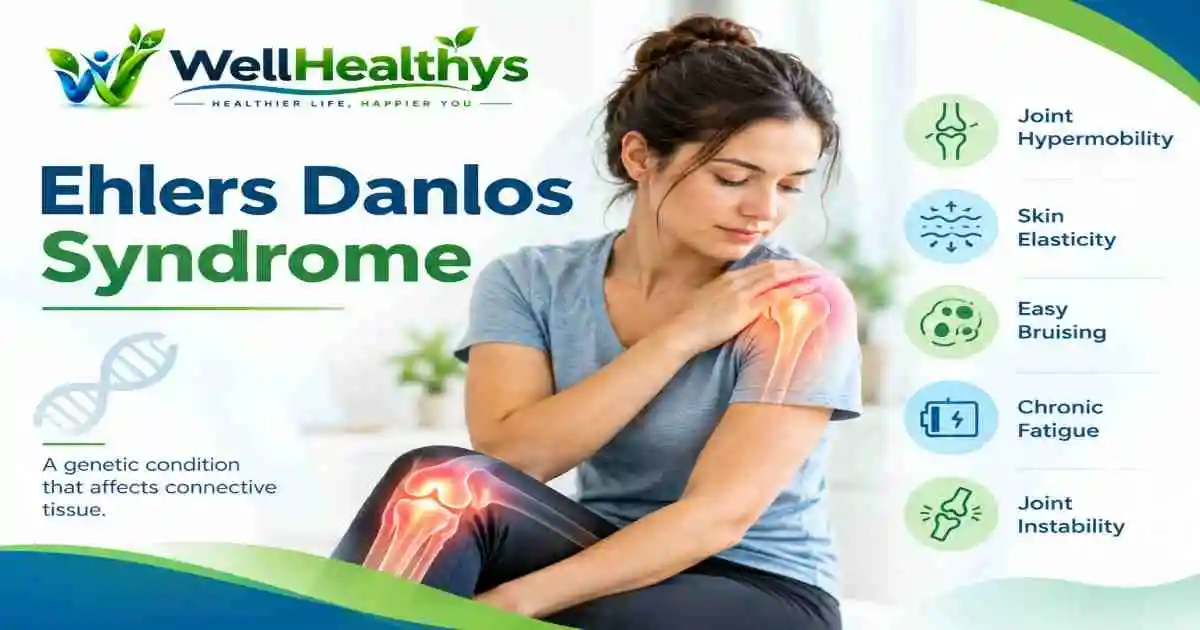
Joints that pop out of place doing ordinary things, skin that bruises if you look at it wrong, and years of being told it’s “just growing pains” or “you’re just flexible.” For a lot of people eventually diagnosed with Ehlers Danlos syndrome, that’s the story leading up to finally getting an answer.
WellHealthys put together this guide to walk through what EDS actually is, the different types, and what living with it really looks like day to day.
What Is Ehlers Danlos Syndrome?

Ehlers Danlos syndrome is a group of genetic disorders that affect how your body produces collagen, the protein that gives structure and strength to your skin, joints, blood vessels, and organs. When collagen doesn’t form correctly, connective tissue throughout the body becomes looser and more fragile than it should be.
According to the Ehlers Danlos Society, there are 13 recognized types of EDS, each with its own genetic cause and diagnostic criteria, though they share some overlapping features like joint hypermobility, stretchy skin, and tissue fragility. EDS is lifelong, usually present from birth even if symptoms aren’t obvious until childhood or later.
According to Cleveland Clinic, EDS affects roughly 1 in 5,000 people overall in the U.S., though hypermobile EDS specifically may be far more common, with some estimates suggesting it affects as many as 1 in 500 people when including milder, undiagnosed cases.
Types of Ehlers Danlos Syndrome

While there are 13 recognized types, a handful account for the vast majority of diagnoses:
Hypermobile EDS (hEDS). By far the most common type. Joints feel loose, click frequently, and may dislocate or partially dislocate (subluxate) with everyday movement. Unlike other types, there’s currently no genetic test for hEDS, so diagnosis relies on clinical criteria.
Classical EDS (cEDS). Similar joint symptoms to hEDS, but with more pronounced skin involvement, soft, stretchy skin, easy bruising, and wide, thin scars that don’t heal typically.
Vascular EDS (vEDS). The rarest and most serious type, affecting blood vessels and organ walls due to reduced type III collagen. It doesn’t typically cause joint hypermobility, but carries a real risk of arterial rupture, organ rupture, and other life-threatening complications.
Kyphoscoliotic EDS (kEDS). Involves weak muscle tone from birth, a progressively curving spine, and often eye issues like severe nearsightedness. Fewer than 50,000 people in the U.S. are estimated to have this type.
Arthrochalasia EDS and other rarer types. Involve specific combinations of joint dislocation (often present at birth), skin fragility, and distinct physical features, each affecting a very small number of people worldwide.
Ehlers Danlos Syndrome Symptoms

Symptoms vary significantly by type and even between people with the same type, but commonly include:
- Joints that are unusually flexible and move beyond a typical range
- Frequent joint subluxations or dislocations, sometimes from minor movements
- Soft, velvety, or stretchy skin
- Skin that bruises easily or tears with minor trauma
- Wide, thin, or unusually textured scars
- Chronic joint or muscle pain
- Fatigue that doesn’t improve with rest
- Digestive issues, including bloating and slow gut motility
- Dizziness or a racing heart when standing, related to dysautonomia, which is common alongside EDS
Hypermobile EDS vs. Hypermobility Spectrum Disorder
This distinction trips up a lot of people, including some clinicians early in the diagnostic process. Joint hypermobility on its own is common and doesn’t always signal EDS. If someone has symptomatic hypermobility, meaning it causes pain or joint instability, but doesn’t meet the full clinical criteria for hEDS or another connective tissue disorder, they’re generally diagnosed with a hypermobility spectrum disorder (HSD) instead.
The symptoms and management overlap heavily between hEDS and HSD, and many specialists treat them similarly in practice, but the distinction matters for research, genetic counseling conversations, and occasionally for how certain specialists approach your care.
What Causes Ehlers Danlos Syndrome?
EDS is caused by genetic mutations that affect collagen production or processing. Most types are inherited in an autosomal dominant pattern, meaning a child only needs to inherit the altered gene from one parent to develop the condition, though some rarer types are recessive, requiring a mutated gene from both parents.
Specific genes have been identified for 12 of the 13 types. Hypermobile EDS remains the exception, with no confirmed single gene identified yet, which is part of why diagnosis for that type still relies on clinical evaluation rather than a blood test.
Vascular EDS: Red Flags That Need Emergency Care
Because vascular EDS carries genuinely serious risks, it deserves its own callout. If you or someone you know has a vEDS diagnosis or suspects it, treat these as emergencies:
- Sudden, severe abdominal, chest, or back pain, which can signal an arterial or organ rupture
- Sudden swelling, especially with severe pain, which can indicate internal bleeding
- Signs of stroke, including sudden weakness, vision changes, or difficulty speaking
- Unexplained, severe pain after any injury, even a seemingly minor one
If any of these occur, especially with a known or suspected vEDS diagnosis, seek emergency care immediately rather than waiting to see if it improves.
How Is EDS Diagnosed?
Diagnosis typically involves a combination of:
- A physical exam, including the Beighton score, a standardized test that measures joint flexibility at specific points on the body
- A detailed personal and family medical history
- Skin examination for signs of hyperextensibility or unusual scarring
- Genetic testing, which can confirm 12 of the 13 types, though not hypermobile EDS
- Referral to a geneticist or EDS specialist for complex or unclear cases
Because symptoms overlap with several other conditions, and awareness among general practitioners varies, many people see multiple doctors over several years before receiving an accurate diagnosis.
How Is EDS Managed?
There’s no cure for EDS, and treatment focuses entirely on managing symptoms and preventing complications, often through a team of specialists rather than a single doctor:
- Physical therapy to strengthen the muscles around unstable joints, which can reduce dislocations over time
- Joint bracing or taping during activities that put extra strain on vulnerable joints
- Pain management, tailored to the individual, since EDS-related pain often doesn’t respond typically to standard approaches
- Cardiology monitoring, particularly for types affecting blood vessels or heart valves
- Low-impact exercise, such as swimming or cycling, which builds strength without the joint strain of high-impact activity
- Occupational therapy to adapt daily tasks and reduce strain on affected joints
Living With EDS: Practical Tips
A few strategies that people managing EDS day to day often find helpful:
- Learn your own warning signs for an impending subluxation or dislocation, since recognizing them early can help you protect the joint before it fully gives way
- Build a care team that communicates with each other, since EDS affects multiple body systems and fragmented care can miss connections between symptoms
- Pace activities rather than pushing through on good days and crashing afterward, a pattern often called “boom and bust” that can worsen fatigue over time
- Connect with the EDS community. Organizations like the Ehlers-Danlos Society offer support groups and resources specifically for navigating life with the condition
- Advocate clearly with new providers, since EDS awareness varies widely even among specialists, and coming prepared with your diagnosis history can save time
Frequently Asked Questions
Is Ehlers Danlos syndrome a disability?
It can be, depending on severity and type. Some people with EDS manage symptoms with minimal disruption to daily life, while others experience significant pain, fatigue, or joint instability that qualifies as a disability. It varies enormously from person to person, even within the same EDS type.
Can Ehlers-Danlos syndrome be cured?
No, there’s currently no cure. EDS is a lifelong genetic condition, and treatment focuses on managing symptoms, protecting joints, and monitoring for complications specific to your type.
Is EDS the same as being double-jointed?
Not exactly. Being “double-jointed” usually refers to general joint hypermobility without other symptoms. EDS involves hypermobility alongside other features like skin fragility, chronic pain, or, in more serious types, risks to blood vessels and organs.
Can you develop Ehlers Danlos syndrome later in life?
No, EDS is genetic and present from birth, even if symptoms aren’t noticeable or diagnosed until later in childhood or adulthood. What can happen later is finally getting a correct diagnosis after years of unexplained symptoms.
Does exercise help or hurt EDS symptoms?
The right kind generally helps. Low-impact strengthening exercise, guided by a physical therapist familiar with EDS, can improve joint stability and reduce dislocations. High-impact or overly strenuous activity without proper guidance can do the opposite, so working with a knowledgeable provider matters.
Getting Support with WellHealthys
Ehlers Danlos syndrome is often misunderstood, sometimes even by the medical providers people turn to first, which makes a clear, accurate explanation matter more than usual. Whether you’re newly diagnosed, still searching for answers, or supporting someone who is, understanding what EDS actually involves is a meaningful first step.
At WellHealthys, we’ll keep building clear, accurate guides on conditions that don’t always get the straightforward explanation they deserve. Explore more in our Health and Diseases & Conditions sections for related guides.
What to Do Next
- Track your symptoms, including joint issues, skin changes, and fatigue patterns, to share with your doctor.
- Ask for a referral to a geneticist or EDS specialist if your symptoms aren’t being fully explained.
- Know the vascular EDS emergency signs above if you or a family member has that diagnosis.
- Subscribe to WellHealthys for more clear, accurate health guides like this one.
Medical Disclaimer
This article is for informational purposes only and is not a substitute for professional medical advice, diagnosis, or treatment. WellHealthys is not a healthcare provider. Always seek the advice of a qualified physician, geneticist, or specialist with any questions about Ehlers Danlos syndrome or related symptoms. Never disregard professional medical advice or delay seeking it because of something you have read here. If you experience sudden severe pain, signs of internal bleeding, or stroke symptoms, call 911 immediately.
About the Author
Written by Prashant Kashyap, Founder at WellHealthys. Prashant is not a licensed medical professional. He researches and compiles health information from established clinical sources, including Cleveland Clinic, NORD, and the Ehlers-Danlos Society, to help readers understand conditions like EDS in plain, accessible language. This article should not replace advice from a qualified doctor or genetic specialist.
