


Last updated: August 2026 | Written by Prashant Kashyap, Founder at WellHealthys

There’s a coder at a startup in Bangalore who runs 5 kilometers every single morning before work. He’s fit, he’s proud of his routine, and he genuinely believes he’s doing everything right. But by 7 PM, his lower back is screaming, his legs feel heavy, and he can’t figure out why. The answer lies in one of the most overlooked risks covered under Wellhealthorganic.com: Health Hazards of Prolonged Sitting: he sits for nearly 10 hours straight after that run, and that run isn’t enough to undo it.
This is the part almost nobody talks about. At WellHealthys, we want to break down what’s actually happening in your body when you sit too long, and more importantly, what genuinely helps, not just the same tired advice you’ve read everywhere else.
What Counts as “Prolonged Sitting”?
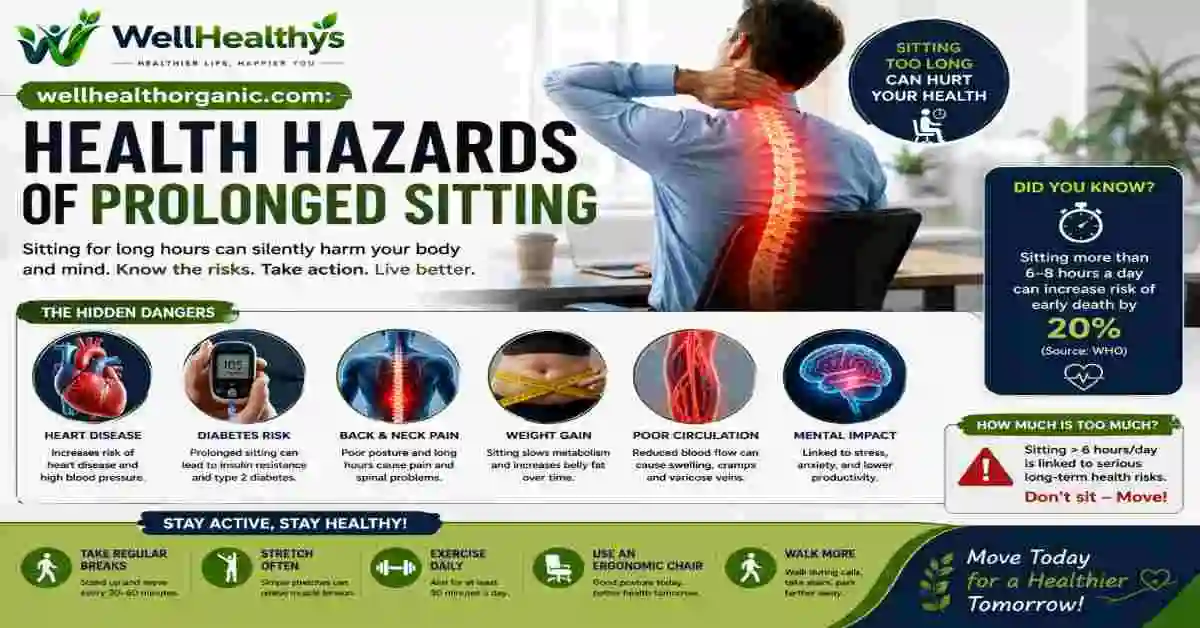
Prolonged sitting means staying seated for long, unbroken stretches, generally more than 6 to 8 hours a day with very few breaks in between. It’s a core part of what researchers call a sedentary lifestyle, and it’s not just about your job either. It adds up across your whole day: the commute, the desk, the couch in front of the TV, the scroll session on your phone before bed.
The WHO guidelines on physical activity and sedentary behaviour specifically call out reducing sedentary time as a public health priority, alongside regular exercise. And here’s the part that surprises people: it’s not limited to office workers anymore. Look at who’s actually affected:
- IT and corporate professionals sitting through back-to-back meetings and long coding sessions
- Students glued to laptops for online classes and exam prep
- Freelancers and remote workers who don’t have a fixed office schedule to force breaks
- Gamers and heavy screen users who lose track of time during long sessions
- Drivers and cab operators who sit for most of their working hours
- Anyone with a generally sedentary lifestyle, regardless of occupation
If you fall into more than one of these categories, and most people today do, this article is for you.
Why “I Exercise Daily, So I’m Safe” Is a Myth

This is where most advice online gets it wrong. There’s a real phenomenon researchers call being an “active couch potato.” It means you can hit the gym for an hour, feel accomplished, and still be at serious health risk because of the other 9 or 10 hours you spend sitting.
Here’s why this happens. Physical activity and sedentary behavior affect your body through different pathways. Exercise strengthens your heart and muscles. But sitting for hours slows your blood flow, reduces an enzyme called lipoprotein lipase that helps break down fat, and keeps your muscles inactive in a way that a single workout session can’t reverse. Interestingly, the Lancet meta-analysis mentioned above found that 60 to 75 minutes of daily moderate activity, more than double the standard 30-minute recommendation, is what it actually takes to offset the mortality risk of 8 hours of sitting. Most people fall well short of that number.
Think of it like brushing your teeth once really well but then eating sugar all day. The one good habit doesn’t cancel the damage from the rest of your day. That’s exactly what happens when someone exercises for 45 minutes and then sits for 9 hours straight, one of the clearest effects of sitting too long even among people who consider themselves fit.
This doesn’t mean exercise is pointless. It absolutely helps, and building strength through consistent movement matters more than most people realize. But treating a single workout as a free pass to sit the rest of the day away is where the real danger lies.
Wellhealthorganic.com: Health Hazards of Prolonged Sitting — What It Does to Your Body
Heart Disease and Poor Circulation
When you sit for long periods, blood flow slows down, especially in your legs. This contributes to higher cholesterol and blood pressure over time. Studies have connected the health hazards of prolonged sitting to a noticeably higher risk of heart disease, independent of how much someone exercises.
Obesity and Metabolic Syndrome
Sitting for extended periods reduces your muscles’ ability to process fat and sugar effectively. Over months and years, this contributes to weight gain, insulin resistance, and a higher chance of developing type 2 diabetes, even in people who otherwise eat well.
Musculoskeletal Problems
Ever notice how your lower back tightens up after a long day at your desk? That’s not random. Sitting compresses your spinal discs and weakens your core muscles over time. Combine that with slouched posture in front of a screen, and you get chronic neck pain, shoulder tension, and lower back issues that creep up slowly and then suddenly feel unbearable.
Varicose Veins and Blood Clots
When you sit for hours, blood tends to pool in your legs instead of circulating properly. This increases the risk of varicose veins and, in more serious cases, deep vein thrombosis (DVT), a condition where blood clots form in deep veins, most often in the legs. Mayo Clinic notes that avoiding crossed legs while seated and taking short walking breaks are two of the simplest ways to lower this risk.
Mental Health and Focus
This one gets overlooked constantly. Reduced circulation from long sitting sessions doesn’t just affect your body, it affects your brain too. Less blood flow means less oxygen reaching your brain efficiently, which can show up as brain fog, low energy, and difficulty concentrating by mid-afternoon. Several studies have also linked long sedentary hours with higher rates of anxiety and low mood. Building in simple self-care habits through the day helps more than people expect here.
NEAT: The Missing Piece Nobody Talks About

Here’s a concept that barely gets mentioned in most articles on this topic, and it might be the most useful thing you read here. It’s called NEAT, short for Non-Exercise Activity Thermogenesis.
NEAT covers all the movement you do that isn’t formal exercise. Fidgeting, standing while you’re on a phone call, walking to grab water, taking the stairs, pacing while you think through a problem. None of it feels like “working out,” but it adds up to real calorie burn and keeps your circulation active throughout the day.
People with naturally high NEAT tend to be leaner and healthier, even if they don’t hit the gym often. The good news is you can boost your NEAT without changing your entire schedule, and pairing it with structured fitness habits gives you the best of both. Stand up during calls. Walk over to a colleague’s desk instead of messaging them. Pace during a podcast. These tiny habits matter more than people realize, and they’re far easier to sustain than trying to squeeze in another workout.
Risks by Occupation and Lifestyle
Not everyone sits the same way, and the fixes aren’t one-size-fits-all either.
IT and corporate professionals often go from one meeting straight into another, sometimes without standing up for hours. Try the 20-20-20 rule here: every 20 minutes, look at something 20 feet away for 20 seconds, and use that as your cue to also shift your posture or stand briefly. Balancing work and wellness starts with exactly these small, repeatable habits.
Students studying for exams or attending back-to-back online classes tend to sit even longer than office workers, often without any structured break at all. Set a timer for every 45 minutes of study and take a strict 5 minute standing break, even if it feels like it’s slowing you down. It isn’t.
Freelancers and remote workers face a different problem. Without office structure, there’s nothing forcing a break. Self-imposed movement alarms work well here. Set a recurring phone alert every hour and treat it as non-negotiable, the same way you’d treat a client call.
Gamers and heavy screen users often lose complete track of time during long sessions. Linking movement to natural breakpoints, like the end of a match or a loading screen, makes it easier to stick with than relying on willpower alone.
Drivers face the added challenge of vibration and constant seated posture with limited control over their schedule. Using rest stops for a short walk and stretch, even for 3 to 5 minutes, makes a real difference over a full day of driving.
Does a Standing Desk Actually Fix This?
A lot of people assume switching to a standing desk solves the problem entirely. It doesn’t, and this is rarely mentioned honestly.
Standing in one place for hours brings its own set of issues, including varicose veins, joint strain, and foot and lower back discomfort. The body isn’t designed to stay locked in any single position for extended periods, whether that’s sitting or standing.
The real solution isn’t choosing one posture over another. It’s alternating between sitting, standing, and moving throughout the day. If you have a sit-stand desk, use it to switch positions every 30 to 45 minutes rather than standing continuously for hours.
Desk Exercises for Office Workers You Can Do Without Leaving Your Chair

You don’t need a gym or even much space to counter some of the effects of sitting too long. Try building these into your day:
- Seated leg raises: Extend one leg straight out, hold for 5 seconds, lower it slowly. Repeat 10 times per leg to keep blood flowing in your lower body.
- Shoulder rolls and neck tilts: Roll your shoulders backward 10 times, then gently tilt your head side to side to release built-up tension in your neck and upper back.
- Seated spinal twist: Sit tall, place one hand on the back of your chair, and gently twist your torso to look behind you. Hold for 10 seconds each side.
- Ankle circles: Lift your feet slightly off the ground and rotate your ankles in circles, 10 times each direction, to keep circulation active in your lower legs.
- Standing desk push-ups: Place your hands on your desk edge, step back slightly, and do a few incline push-ups. Great for a quick blood flow boost between tasks.
A realistic break schedule to pair with these: stand up and move for at least 2 to 3 minutes every 30 to 45 minutes, even if it’s just a short walk to refill your water bottle.
How Much Sitting Is Actually Safe? Quick Self-Check
Use this as a rough gauge of where you stand:
- Under 4 hours of sitting a day, with regular movement: low risk
- 4 to 6 hours of sitting a day, with occasional breaks: moderate risk
- 6 to 8+ hours of sitting a day, with few or no breaks: high risk
If you landed in the moderate or high risk zone, don’t panic. Most people do. What matters now is building in the small habits covered above, starting today rather than waiting for a wake-up call.
FAQs
Is 8 hours of sitting really that bad?
Yes, especially if it’s continuous with few breaks. Research consistently links 8 or more hours of daily sitting with a significantly higher risk of heart disease, diabetes, and early mortality, even among people who exercise regularly.
Can standing desks reverse the damage?
They help, but only if you alternate between sitting and standing rather than standing continuously. Standing all day brings its own risks, so movement and posture variety matter more than the desk type itself.
How many breaks should I take per day?
Aim for a short movement break every 30 to 45 minutes. Even a 2 to 3 minute walk or stretch session makes a measurable difference over a full day.
Does exercising after work undo a full day of sitting?
Not entirely. This is the active couch potato effect. Exercise offers major health benefits on its own, but it doesn’t fully cancel out the effects of sitting too long across many continuous hours. Both matter, and neither replaces the other.
What are early warning signs of too much sitting?
Common early signs include lower back stiffness, tight hips, poor posture, afternoon energy crashes, and difficulty concentrating later in the day. These are your body’s way of signaling it needs more movement.
Kya roz gym jaane se prolonged sitting ka nuksaan khatam ho jaata hai?
Nahi, poori tarah nahi. Agar aap 1 ghanta gym karte ho lekin baaki 8-9 ghante bina break ke baithe rehte ho, toh risk kaafi had tak wahi rehta hai. Isiliye chhoti-chhoti movement breaks poore din me lena zaroori hai, sirf ek workout session kaafi nahi hai.
Office me kaam karte waqt sitting ka nuksaan kaise kam karein?
Har 30-45 minute me 2-3 minute ke liye khade ho jao, thodi walk karo ya seated stretches karo. 20-20-20 rule follow karo, aur agar sit-stand desk hai toh position regularly change karte raho.
Kitne ghante baithna safe maana jaata hai?
Roughly 4 ghante se kam sitting, regular movement ke saath, low risk maana jaata hai. Agar aap 6-8 ghante ya usse zyada bina break ke baithte ho, toh ye high risk category me aata hai.
Students ke liye prolonged sitting se bachne ka best tarika kya hai?
Study session ko 45 minute ke blocks me todo aur har block ke baad 5 minute ka standing break lo. Ye chhota sa habit focus aur health, dono improve karta hai, chahe pehle thoda slow lage.
Pick One Habit and Start Today
You don’t need to overhaul your entire day to cut down the health hazards of prolonged sitting. Choose a single habit from this guide, a 20-minute break timer, a set of seated stretches, or a short walk after lunch, and stick with it for the next 3 days before adding another. Small, repeatable movement beats one big workout every time.
Explore more WellHealthys guides on wellhealthorganic fitness and healthy life wellhealthorganic to keep building habits that actually stick.
About the Author
This guide was written by Prashant Kashyap, the writer behind WellHealthys, covering fitness, workplace wellness, and everyday movement habits for readers who spend most of their day at a desk. You can read more guides like this one in the Wellness section on WellHealthys.
Disclaimer
The information in this guide is meant for general awareness and is not a diagnosis or treatment plan. Sitting-related risks such as DVT, chronic back pain, or cardiovascular concerns should be evaluated by a doctor, especially if you already experience swelling, persistent pain, or numbness in your legs. Movement suggestions here are general in nature and may not suit everyone, particularly those recovering from surgery or managing an existing condition. For our full policy, see the WellHealthys Disclaimer.
