


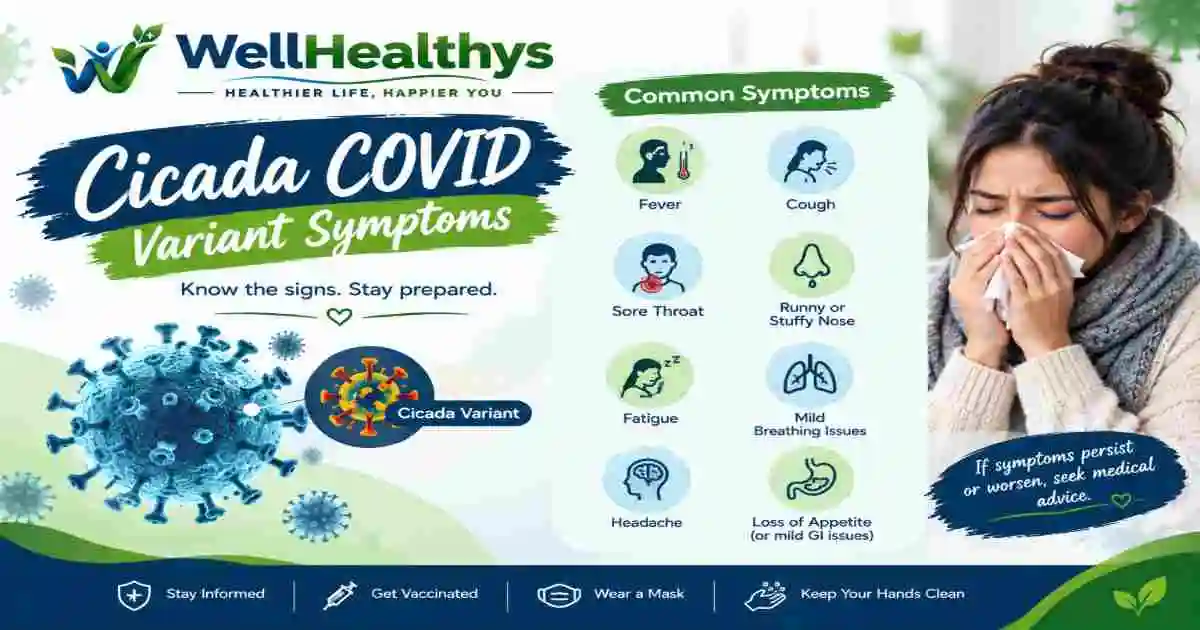
Cicada COVID variant symptoms in brief: The Cicada COVID variant (BA.3.2) causes fever, cough, sore throat, a blocked or runny nose, tiredness, headache and body aches, the same symptoms as other Omicron subvariants. Loss of smell or taste and nausea are less common. WHO and CDC have not reported a symptom unique to BA.3.2, and WHO has found no substantial rise in disease burden linked to its spread.
Key data points (checked 16 October 2026):
- Common symptoms: fever or chills, cough, sore throat, blocked or runny nose, tiredness, headache, body aches
- Less common: nausea, vomiting, diarrhoea, loss of smell or taste, mild breathlessness
- Incubation: 2 to 5 days, sometimes up to 14 (CDC timing quoted by USA Today)
- Recovery: most people improve in 3 to 7 days and recover in 1 to 2 weeks (Apollo Hospitals)
- First detected: sample collected 22 November 2024 in South Africa (CDC)
- WHO status: variant under monitoring since 5 December 2025, still listed on 27 July 2026
- Spread: at least 23 countries by 11 February 2026 (CDC); about 30% of sequences in Denmark, Germany and the Netherlands between November 2025 and January 2026
- Severity: no substantial rise in disease burden linked to BA.3.2 (WHO, May 2026)
- Urgent care: oxygen reading below 94%, trouble breathing, chest pain, confusion, or fever beyond three days
Why this matters this week: in India, October and November bring viral fever, flu, dengue and COVID, and they all love to start with the same complaint. Picture a 34-year-old in Pune who wakes up with a scratchy throat and a fever of 101°F (38.3°C). This is an illustrative case, not a real patient. Is it the new COVID variant, a flu bug, or the first day of dengue? Symptoms alone cannot settle that, but a few details tell you what to do next.
This WellHealthys guide separates what WHO and CDC have confirmed from what social media has added. It compares COVID vs flu vs dengue symptoms, and it lists the signs that mean you should see a doctor without waiting.
What Is the Cicada COVID Variant (BA.3.2)?
Cicada is a nickname for BA.3.2, an Omicron subvariant of the coronavirus that causes COVID-19. Researchers and the media borrowed the insect’s name because the variant stayed quiet for a long time and then resurfaced, much like cicadas that spend years underground. WHO and CDC use the scientific name, BA.3.2.
The timeline is short and well documented. According to CDC’s surveillance report, the first sample was collected in South Africa on 22 November 2024. The first US detection came on 27 June 2025, in a traveller arriving from the Netherlands. WHO then listed BA.3.2 as a variant under monitoring on 5 December 2025 (WHO variant tracker). That label means scientists are watching it closely. It does not mean the variant is a variant of concern. WHO’s tracker, last updated on 28 July 2026, still lists BA.3.2 as a variant under monitoring, alongside NB.1.8.1, XFG and PQ.16.1.1, a newer variant added on 27 July 2026.
Cicada variant vs Omicron: BA.3.2 is itself part of the Omicron family, so the illness feels alike. The difference is genetic. BA.3.2 descends from BA.3, an old Omicron branch that had faded away, and it carries many changes in the spike protein. WHO’s May 2026 statement calls it antigenically distinct from the JN.1 family that has dominated recent years. In plain words, antibodies from earlier infections or vaccines recognise it less well in laboratory tests.
Cicada COVID Variant Symptoms: The Confirmed List
The BA.3.2 variant symptoms reported most often are fever or chills, cough, sore throat, a blocked or runny nose, tiredness, headache and body aches. These match what doctors have seen with Omicron-family infections for years, and the infection mostly sits in the upper airway, meaning the nose and throat.
| Symptom | How it is reported | Good to know |
| Sore throat | Common | Often one of the first signs |
| Cough, usually dry | Common | Can hang around after the fever is gone |
| Fever or chills | Common | Can be mild or low grade |
| Blocked or runny nose, sneezing | Common | Easy to mistake for a cold or allergy |
| Tiredness | Common | Can last longer than the other symptoms |
| Headache and body aches | Common | Feels like the start of flu |
| Nausea, vomiting or diarrhoea | Less common | Seen in some cases, usually with the cold-like signs |
| Loss of smell or taste | Less common | Reported less often than with early COVID variants |
| Mild breathlessness | Less common | Breathlessness at rest is a red flag (see the doctor section) |
One honest limit: CDC’s BA.3.2 report is about genetics and surveillance, not symptoms. The list above comes from doctors and health reporters, including The Week India and Apollo Hospitals. Larger clinical studies will refine it, so treat the list as a guide to what to expect, not a checklist that proves or rules out COVID.
Severe Sore Throat, Rashes, Children: Which BA.3.2 Claims Hold Up?
Most of the viral claims about this variant are single observations repeated until they sound like facts. The Cicada COVID variant sore throat claim is a good example. Sorting claims by source makes the picture clearer.
| Claim you may have seen | Where it comes from | Verdict |
| BA.3.2 causes an unusually severe sore throat | One US infectious disease expert quoted in news reports | Anecdote. No agency lists it as a defining symptom |
| Children catch it more often | WHO says BA.3.2 is a bigger share of sequences from young children than adults in several countries | Possible, not proven. WHO says numbers are low and the finding needs caution |
| It causes rashes or night sweats | A few health websites list them as occasional | Unverified. Ask your doctor if you have them |
| It is more dangerous | Social media and some headlines | Not supported. WHO says the rise in BA.3.2 has not come with a substantial rise in disease burden |
A real example shows why small stories mislead. CDC’s report describes the first three US patients found with BA.3.2: two older adults with other health conditions who were in hospital, and a young child treated as an outpatient. All three survived. CDC itself warns that a handful of hospital cases does not show the variant causes severe disease.
On children, WHO offers a reason that sounds sensible: younger children have had less exposure to early COVID variants, so they may have less cross-protection. That is a hypothesis, and WHO has asked countries for better data on young children before drawing conclusions. If you are a parent, the practical takeaway is simple: watch your child the way you would for any respiratory infection, and use the red-flag list later in this guide.
BA.3.2 vs Flu, Dengue and RSV: How Do the Symptoms Differ?
You usually cannot tell COVID from flu by symptoms alone, and CDC says exactly that. Dengue follows a different pattern, which is why it deserves its own column in this COVID vs flu vs dengue symptoms comparison. In India, dengue cases typically climb after the monsoon, so the same week can bring all four illnesses to the same clinic.
| Feature | BA.3.2 COVID | Flu | Dengue | RSV |
| Cough and sore throat | Common | Common | Not typical | Cough is common |
| Runny or blocked nose | Common | Common | Not typical | Very common |
| Fever | Can be mild | Often high | Usually high | May be mild or absent |
| Body and joint pain | Common, usually mild to moderate | Common, can be marked | Severe, often called breakbone pain | Less common |
| Pain behind the eyes | Rare | Rare | Typical | Not typical |
| Rash | Rare | Rare | Can appear a few days in | Rare |
| Loss of smell or taste | Possible | Rare | Not typical | Rare |
| What confirms it | Rapid antigen test or RT-PCR | Flu test | Blood tests, such as NS1 antigen and platelet count | Test, mainly for infants and older adults |
Three habits help. If cough and sore throat lead the picture, a COVID test makes sense. If fever arrives with fierce body ache and pain behind the eyes, ask for a dengue test. If you cannot tell, a doctor can order both.
One safety note: for a fever that could be dengue, doctors usually advise paracetamol and avoid ibuprofen or aspirin because of bleeding risk. Check with your doctor before taking any painkiller.
How Do Symptoms Usually Unfold, Day by Day?
Most people feel better within a week, and the whole illness usually settles in one to two weeks. Here is the typical path, based on CDC timing quoted in USA Today and the recovery guidance from Apollo Hospitals.
- Exposure (day 0). You meet someone infected, often in a crowded or poorly ventilated room. You feel completely fine.
- Days 2 to 5 (sometimes up to 14). The first signs appear: a scratchy throat, tiredness, a blocked nose or a mild fever.
- Days 3 to 7. Symptoms peak for most people, then start to ease.
- Weeks 1 to 2. Full recovery is typical. Fatigue or a mild cough may linger a little longer.
- Any point. A fever that returns, or symptoms that worsen after you felt better, is a reason to call a doctor.
You can pass the infection on even when your symptoms are mild, which is why staying home while unwell is the standard advice.
When Should You Get Tested, and Which Test Works?
Get tested when you have symptoms, after close contact with a confirmed case, or before you spend time with an elderly or high-risk relative. The test you already know works. A fact-check review of the science, published by FactCrescendo, reports that commonly used multi-target PCR tests still detect BA.3.2. Naming the exact variant needs genomic sequencing, which labs do for surveillance. Your care does not depend on it.
- Rapid antigen test. Quick, available at home or in a clinic, and best in the first days of illness. If you have symptoms and the result is negative, repeat it after a day or two before you relax.
- RT-PCR test. A lab test that is more sensitive and takes longer. Apollo Hospitals lists it as the gold standard and recommends it for people with symptoms who are also at high risk.
A negative COVID test with a fever does not close the case. It is a good moment to think about flu or dengue and call your doctor.
Red Flags: When Should You See a Doctor Without Waiting?
See a doctor the same day if any of these appear, whatever the variant:
- Difficulty breathing, or breathlessness while resting
- Chest pain or pressure that does not go away
- Confusion, or unusual drowsiness that makes it hard to wake someone
- Bluish lips or face
- A pulse oximeter reading below 94%, the cut-off Apollo Hospitals lists for immediate care
- Fever lasting more than three days, or a fever that returns after you had started to improve
People at higher risk should not wait for red flags. That group includes adults over 60, people with diabetes, heart, lung or kidney disease, a weak immune system, and pregnant women. Call your doctor early, even if symptoms feel mild, and ask whether antiviral treatment makes sense for you.
For children, fast or laboured breathing, refusing feeds or fluids, unusual sleepiness and a bluish tinge around the lips need urgent care. If dengue is on your mind, severe stomach pain, repeated vomiting, bleeding from the gums or nose, or extreme restlessness as the fever drops also need an emergency visit.
Is BA.3.2 More Dangerous, and Do Vaccines and Antivirals Still Help?
There is no evidence so far that BA.3.2 makes people sicker than other recent variants. WHO’s May 2026 statement says BA.3.2 appears less fit than the JN.1-family variants, has not displaced them where it has been found, and its rise has not come with a substantial increase in disease burden. CDC’s surveillance report adds that lab studies found weaker lung cell entry, which may limit how far it can spread.
Denmark, Germany and the Netherlands show how this played out in real life. Between November 2025 and January 2026, BA.3.2 reached about 30% of sequences reported there, yet CDC notes that overall COVID incidence was not substantially higher than in earlier years.
Vaccines. On the BA.3.2 vaccine question: WHO has not recommended a BA.3.2-specific vaccine, and the recommended antigen stays monovalent LP.8.1 as of May 2026. Antibodies recognise BA.3.2 less well than recent variants. In laboratory tests, blood from people vaccinated with the LP.8.1 vaccine neutralised it less strongly than other variants, according to both WHO and CDC. That does not make vaccines pointless. WHO says LP.8.1 still produces broadly cross-reactive immune responses, but it also admits there are no real-world effectiveness estimates yet from places where BA.3.2 was the main variant. So protection against severe illness is expected, not yet measured. WHO advises that high-risk groups should not delay vaccination while waiting for updated formulas.
Antivirals. Experts quoted in Clinikk’s guide say current COVID antivirals still work against it. They are prescription medicines that work best early, so a high-risk person should call a doctor on the first day, not self-medicate.
Is the New COVID Variant (Cicada) in India Right Now?
So, is the Cicada variant in India? Indian reporting from spring 2026 found no BA.3.2 outbreak in the country. On 3 April 2026, a Mumbai chest physician told The Week India that no such trend had been seen here and there was no need to panic, while accepting that the variant could eventually arrive. Clinikk said the same in April: no major outbreak linked to BA.3.2 had been confirmed.
On new COVID variant symptoms in India, we did not find any India-specific symptom data, so the global picture described above is the best guide for now.
[Editor: replace this section’s status lines with the latest position from MoHFW, NCDC and INSACOG, with the date, before publishing.]
Two cautions help you read any “no cases” headline. First, CDC and WHO both say limited sequencing means detections undercount the real spread, so a quiet headline is not proof of zero cases. Second, the wider picture is calm: WHO reports that in 2026 all its regions have had lower COVID test positivity than in the same period of earlier years.
For live updates, check the Ministry of Health and Family Welfare, the National Centre for Disease Control, INSACOG and your state health department. Trust those pages over forwarded messages.
How Can You Protect Yourself and Your Family?
The basics that worked against earlier waves still work, and none of them needs to be dramatic. Here is how they look in an Indian week:
- Stay home when you are unwell. Skip the office, school and the family function until the fever is gone and you are clearly improving.
- Open the windows. Fresh air in homes, cars and small offices lowers the amount of virus hanging in the room. In crowded local trains, lifts and markets, a well-fitted mask is the practical choice.
- Wash your hands. Soap and water first. Use a sanitiser with at least 60% alcohol when there is no sink.
- Protect older relatives. If you have a cough or sore throat, put the visit to your grandparents on hold and test before you go. This matters most in festival season, when homes fill up.
- Ask about vaccination. WHO advises routine vaccination for groups at highest risk of severe COVID. If you are over 60 or have a long-term condition, ask your doctor what suits you.
Frequently Asked Questions
Is the Cicada COVID variant more severe than earlier variants?
Not so far. WHO reports that the rise of BA.3.2 has not brought a substantial increase in disease burden, and CDC cautions that a few hospital detections do not prove severity. Older adults and people with other health conditions still face higher risk from any COVID infection, so the usual precautions apply.
Does BA.3.2 cause loss of smell or taste?
Sometimes, but it is a less common symptom, and doctors report it less often than with early COVID variants. A normal sense of smell does not rule COVID out, and losing it does not confirm this variant. A test is the only reliable way to know.
Are children more likely to catch BA.3.2?
Possibly. WHO notes that in several countries BA.3.2 is a larger share of sequences from young children than from adults, and it suggests less earlier exposure as one reason. The numbers are small, so WHO urges caution and has asked for better data on how severe it is in young children.
Will a normal COVID test pick up the Cicada variant?
Commonly used PCR tests still detect BA.3.2, according to a fact-check review of the science. We did not find BA.3.2-specific data on home rapid tests. If a rapid test is negative but you clearly feel unwell, repeat it after a day or two or ask your doctor about a PCR test.
Can I get it again if I have already had COVID?
Yes. WHO’s laboratory data show that antibodies from earlier infections and vaccines recognise BA.3.2 less well than recent variants, so reinfection is possible. Prior immunity usually still helps keep the illness milder, according to Apollo Hospitals.
Cicada COVID variant India me hai ya nahi?
April 2026 tak Indian reports me BA.3.2 ka koi bada outbreak confirm nahi hua tha. Lekin sequencing kam hone se asli spread kam dikh sakta hai, isliye latest status ke liye MoHFW, NCDC aur INSACOG ke pages dekhein, aur forwarded messages par bharosa na karein.
Bukhar aur gale me dard ho to COVID, flu ya dengue kaise pata chalega?
Sirf symptoms se pakka pata nahi chalta. Khansi aur gale ka dard zyada ho to COVID test karwayein. Tez bukhar ke saath bahut zyada body pain aur aankhon ke peeche dard ho to doctor se dengue test (NS1, platelet count) ke bare me poochein. Samajh na aaye to doctor dono test likh sakte hain.
Cicada variant me doctor ko kab dikhana chahiye?
Saans lene me takleef, seene me lagataar dard, confusion, hothon ka neela padna, oxygen 94% se kam, ya 3 din se zyada bukhar ho to usi din doctor ko dikhayein. 60 saal se upar ya diabetes, heart, lung ya kidney ki bimari wale log halke symptoms me bhi jaldi doctor ko call karein.
What to Do Next
Here is your three-step plan for cicada covid variant symptoms or any sudden fever this season:
- Test early. Use a rapid antigen test or book an RT-PCR test, and repeat a negative rapid test after a day or two if you still feel unwell.
- Rest and watch the red flags. Stay home, keep an eye on breathing and oxygen, and call a doctor the same day if any red flag from this guide appears.
- Protect the vulnerable. Keep away from older relatives and anyone with a long-term condition until you recover.
Keep this page handy for the next time a fever starts in your house, and pass it on to anyone who looks after an older relative.
Still have a question about Cicada COVID variant symptoms or another seasonal illness? Send it through WellHealthys Contact Us and we will consider it for an upcoming guide. For everyday conditions, browse our Diseases & Conditions section.
Medical Disclaimer
This article on Cicada COVID variant symptoms is for general education only. It is not a diagnosis, a treatment plan or a substitute for advice from a qualified doctor. Do not delay or ignore medical advice because of something you read here. If you or a family member feels very unwell, contact a doctor or call 112, India’s emergency number. Read our full WellHealthys disclaimer.
