


Why this guide matters
Maybe your doctor just used the word “dialysis” for the first time, and the rest of the conversation blurred. Maybe your father has been going to a dialysis unit for months, and you still don’t know what happens inside those four hours. Either way, you’re not alone. Many people ask how is dialysis done for the first time after a hospital stay, when there’s little time to ask questions.
This guide walks through the process step by step, so you can prepare for your own care or support someone you love. It explains both main methods, what a session feels like, how to look after your access point, and where to get care in India. It is written by the WellHealthys health content team and reviewed for accuracy, but it doesn’t replace advice from your nephrologist or dialysis team, who know your full medical history.
What dialysis does, and why it’s needed
Healthy kidneys work like a filter. They remove waste products, extra salt, and excess water from your blood, and they send the waste out as urine. When kidney function drops far enough, waste builds up in the body. People can feel this as tiredness, nausea, swelling, poor appetite, or itching, and the buildup can become dangerous if left untreated.
Dialysis takes over that filtering job artificially. It is commonly used as a kidney failure treatment and for end-stage kidney disease, where the kidneys can no longer keep up with the body’s needs. It doesn’t cure kidney disease, but it keeps the body’s chemistry in balance so a person can stay well enough to live their life. To learn more about kidney and other long-term conditions, browse our health conditions section.
Some people need dialysis for a short time. For example, a kidney injury caused by severe infection, dehydration, or certain medicines may recover with a few weeks of treatment. Others need it long term, sometimes for many years, while they wait for a transplant or manage kidney failure without one. Your care team will tell you which situation applies to you, and they’ll explain whether a kidney transplant is an option to discuss.
The two main types: hemodialysis and peritoneal dialysis

There are two main ways to do dialysis, and both work on the same principle: waste and extra fluid move from the blood into a cleaning solution across a filter or a membrane. They differ in where the cleaning happens and how often you need treatment.
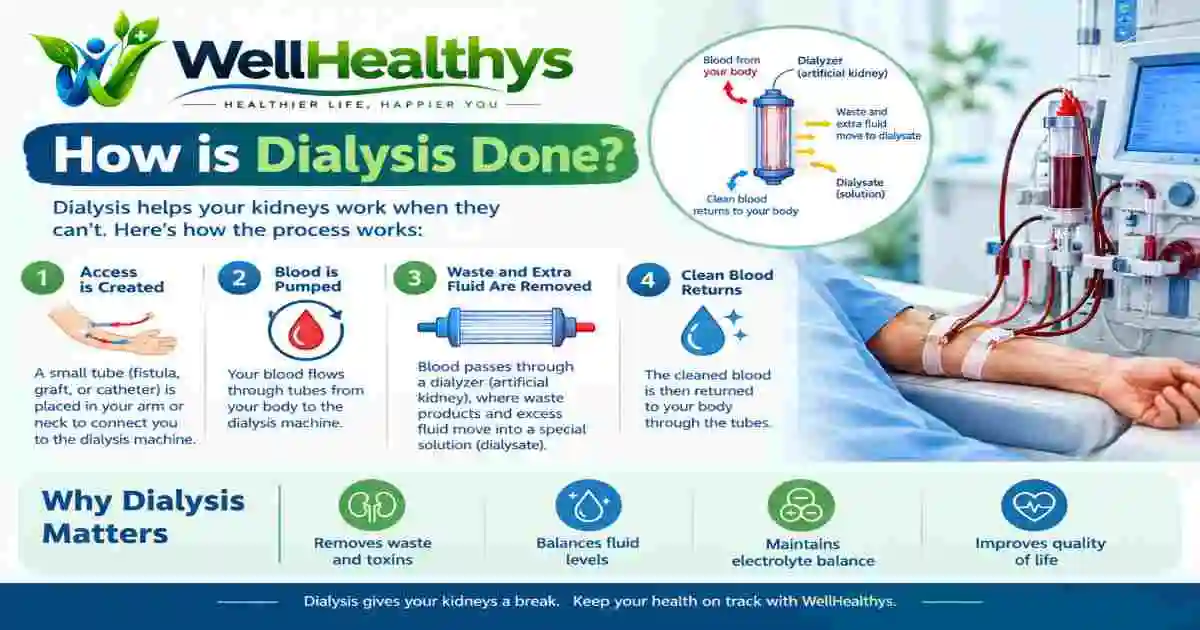
Hemodialysis uses a machine outside the body. Blood travels through a tube to a filter, gets cleaned, and returns to the body. Most people have it at a dialysis unit or hospital.
Peritoneal dialysis uses the lining of your abdomen, called the peritoneum, as the filter. A cleaning fluid goes into your belly through a catheter, sits there for a set time, and then drains out carrying waste with it.
| Feature | Hemodialysis | Peritoneal dialysis |
| Where it’s done | Dialysis unit or hospital (home is possible in some cases) | Usually at home, sometimes while you sleep |
| How often | Typically three sessions a week | Usually daily |
| Length of each treatment | About four hours per session | Shorter exchanges during the day, or a longer overnight cycle |
| What it needs | Regular travel to a centre, an access point in the arm (fistula) or a catheter | A catheter in the abdomen, a clean space at home, daily routine |
| Who it often suits | People who prefer scheduled centre visits or have limited space at home | People who want more flexibility or fewer hospital trips |
Your nephrologist will consider your overall health, your daily life, and your preferences before recommending one method. Many people switch methods over time, so it helps to ask your team what options are available at your centre.
How hemodialysis is done in a session

A hemodialysis process follows a predictable routine, and knowing it in advance makes the first visit less intimidating. Here is the simple version:
- Check weight, blood pressure, and the access point before treatment starts.
- Connect the needles to the access point, usually a fistula in the arm.
- Blood is filtered by the dialysis machine for about four hours.
- The needles are removed, and gentle pressure is applied until the site stops bleeding.
Now let’s walk through each part in more detail.
Before the session. The nurse checks your weight, blood pressure, and temperature. They’ll ask how you’ve been feeling, whether you’ve been drinking more fluid than advised, and whether you’ve had any cramps, swelling, or fever since your last session. Blood tests may be taken to check potassium, haemoglobin, and other levels.
Connecting to the machine. The nurse examines your AV fistula, which is a connection between an artery and a vein, usually in the arm. They clean the skin and place two needles into it, one to draw blood out and one to return it after cleaning. Some people use a graft (a synthetic tube) or a catheter in the neck or chest instead, and the process is similar. The needle placement may sting for a moment, and many people find it’s less painful than they expected once they settle in.
During the session. Your blood flows through the dialysis machine, where a filter removes waste and extra fluid. The cleaned blood returns to your body through the second needle. A typical dialysis session lasts about four hours. During this time, you can rest, read, watch something, or sleep. Nurses check your blood pressure and monitor the machine regularly.
Ending the session. Near the end, the nurse returns your remaining blood to your body and removes the needles. They press gently on the site until the bleeding stops, then cover it with a dressing. Before you leave, they’ll usually weigh you again and check your blood pressure.
Ravi’s father, a retired teacher in his sixties, found the first two sessions the hardest. He said the needle felt like a small pinch, but the tiredness afterwards surprised him more. By the fourth week, he had settled into a routine: a light breakfast, a short walk to the bus stop, and a nap after each session. He still considers that routine the key to coping with treatment. (This is an illustrative example, not a real patient account.)
How peritoneal dialysis is done, step by step
Peritoneal dialysis starts with a small procedure to place a soft catheter in the abdomen. The catheter usually needs a few weeks to heal before you can begin treatment, so your team will tell you when it’s safe to start.
Once you’re ready, treatment works in cycles called exchanges. Each exchange has three parts:
- Fill. Fresh dialysis fluid flows from a sterile bag through the catheter into your abdomen.
- Dwell. The fluid stays in your belly for a set period, while waste and extra fluid move across the lining into the solution.
- Drain. The used fluid drains out into an empty bag, and the cycle starts again.
There are two common ways to schedule these exchanges. With CAPD (continuous ambulatory peritoneal dialysis), you perform several manual exchanges during the day, usually at home or work. With automated peritoneal dialysis, a small machine runs the exchanges while you sleep. Your team will recommend the schedule that fits your routine.
Clean technique matters a great deal here, because the catheter opens a direct path into the abdomen. Wash your hands thoroughly, wear a mask if your team advises it, and keep the connection area clean and dry. Most people learn these steps during a training period with a nurse, and they practise until the routine feels normal.
Caring for your dialysis access point
Your access point is the lifeline of your treatment, so it deserves daily attention. The type of access depends on your method and situation.
If you have a fistula, a surgeon connects an artery to a vein, usually in the arm. This makes the vein stronger and larger over time, which is why fistulas often take several weeks to a few months to become ready for use. Once it’s working, you can feel a steady buzz or vibration under the skin, called a “thrill.” Check for it every day, and tell your team right away if it weakens or disappears.
To protect your fistula, avoid blood draws, blood pressure readings, and IVs in that arm unless your care team says otherwise. Avoid tight watches, bracelets, and clothing that squeezes the arm. Don’t sleep on it or carry heavy bags on it.
If you have a catheter, keep it dry and clean. For peritoneal dialysis, follow the dressing instructions exactly and avoid swimming or baths unless your team has cleared them. Report any leaking fluid, redness, pain, or cloudy drainage immediately.
What dialysis feels like, during and after treatment
Honest expectations help a lot, so here’s what most people experience.
Many people feel tired after a session, and some feel light-headed, nauseous, or cold. Cramps are common, especially in the legs, and they can happen during or after treatment. Itching is also common for some people. These symptoms often ease as your body adjusts and as your fluid and diet are better balanced.
The first few weeks can be the hardest, because everything is new. Most people find that the early anxiety fades once the routine feels familiar. If you’re struggling with worry or low mood, our page on managing stress and emotional health offers general guidance, and your care team can connect you with counselling if you need it. If something feels wrong during a session, tell the nurse immediately. Staff would much rather adjust the treatment than wait for a problem to get worse.
To make sessions more comfortable, ask your team about numbing cream before needle placement, which many units can provide. Bring a blanket, a book or a charged phone, and a small snack if your team allows food. Plan to rest for the rest of the day after a session, rather than pushing straight into errands.
Living with dialysis: diet, fluids, work, and travel
Daily life changes with dialysis, but many people keep working, travelling, and spending time with family.
Fluid restriction is one of the most important parts of your routine. Because your kidneys can’t remove extra water, fluid builds up between sessions. Too much fluid can strain your heart and lungs and raise blood pressure. Your team will set a daily limit based on your urine output, weight gain between sessions, and blood pressure. Simple tricks help: use a small cup, sip slowly, suck on ice chips, and chew sugar-free gum to ease thirst.
A good dialysis diet is individual, but most people need to watch three minerals. Potassium builds up in the blood when the kidneys can’t remove it, and high levels can affect the heart. Sodium drives thirst and fluid retention. Phosphorus can weaken bones. A renal dietitian can help you plan meals that are enjoyable and balanced. For general ideas on building balanced meals, see our guide to healthy eating basics. Here’s an example of how a day might look for someone on hemodialysis, to be adjusted with your dietitian:
- Breakfast: Idli or poha with a small serving of low-potassium fruit such as apple, and a cup of tea with measured milk
- Lunch: Phulka, a small portion of dal, and a vegetable such as bottle gourd or cabbage, cooked without heavy salt
- Snack: Roasted makhana or a small handful of unsalted popcorn
- Dinner: Plain rice or roti, paneer or fish in moderate portions, and a cooked vegetable
Some foods, such as bananas, tomatoes, potatoes, coconut water, and many pickles and papads, can be high in potassium or sodium. Ask your dietitian which ones to limit.
Work is possible for many people, especially those on home dialysis or those with flexible schedules. Plan sessions around your job, and talk to your employer early if you need time off. Exercise helps many people feel better, so ask your team about safe activities, especially if you have a fistula. For everyday routines that support energy and sleep, see our tips on healthy daily habits. Travel takes planning. Arrange your sessions at a dialysis unit in your destination before you leave, and carry a copy of your treatment records.
Home dialysis: what it requires
Home dialysis is an option for many people, but it asks more of you and your family. Training usually takes several sessions with a nurse, and you’ll learn to set up the equipment, monitor your blood pressure, and respond to alarms or problems.
For home hemodialysis, you need a clean, dedicated space, reliable electricity, and a water treatment system that removes impurities from tap water. For home peritoneal dialysis, you need a clean area for each exchange and enough storage for supplies.
A caregiver, often a family member, may need to be trained too, especially for home hemodialysis. Caregivers help with setup, monitoring, and emergencies, and they’re an important part of the team. Be honest with your nephrologist about your home situation, because eligibility depends on it.
Dialysis cost in India, and where to get care
Access to dialysis in India varies by state, city, and income. Understanding your options early can save time and money. If you’re looking for a dialysis centre near me, start with your nearest government hospital, then compare private options.
Government hospitals often provide dialysis at lower cost or free of charge to eligible patients, depending on the state and the type of care needed. Waiting lists can be long, so ask the hospital about the process and timelines.
Private dialysis centres offer more flexible timings and sometimes faster access, but costs can be significant. Ask for a written estimate that covers sessions, medicines, tests, and any extra charges, so you can understand the full dialysis cost in India before you start.
Health insurance and government schemes may cover part of your dialysis, depending on your policy and eligibility. Ayushman Bharat PM-JAY is one scheme that may apply, depending on your household details and your state’s participation. Check the official website or your local scheme office before you assume coverage.
Charitable and subsidised options exist in some areas, often run by trusts or community organisations. They can be a useful backup, especially for long-term care.
Before choosing a centre, ask these questions: How many sessions do you run each week? What happens if the machine fails during treatment? Is there a doctor on call? How do you control infection? Who do I call in an emergency after hours?
Cost and scheme details change over time, so confirm them with the hospital, insurer, or official government website before making decisions.
Warning signs that need urgent care
Dialysis is generally safe when it’s done under proper supervision, but some symptoms need prompt attention. For more general information on when to seek help, see our general health topics page. Contact your dialysis team or go to the nearest emergency department right away if you notice any of these:
- Fever, chills, or shaking during or after a session
- Redness, swelling, warmth, or pus at the needle site or the catheter exit site
- Chest pain, shortness of breath, or a racing heartbeat
- Severe dizziness, fainting, or confusion
- Severe muscle cramps that don’t ease
- A fistula that no longer has a thrill, or a fistula that bleeds and won’t stop
- For peritoneal dialysis, cloudy drainage fluid or abdominal pain that doesn’t settle
If you’re worried about someone’s condition and can’t reach their care team, call 108 for an ambulance or 112 for the national emergency number.
Frequently asked questions
How is dialysis done, step by step?
In hemodialysis, your blood is cleaned by a machine during a session of about four hours, usually three times a week. In peritoneal dialysis, cleaning fluid is filled into your abdomen, left to work for a set time, and then drained out, usually every day.
Is dialysis painful?
Most people feel a brief pinch when the needles go in, and some feel discomfort during the session from cramps or positioning. Numbing cream and good communication with the nurse help a lot. Many people say the tiredness afterwards is harder to handle than the procedure itself.
How many times a week is dialysis done?
Hemodialysis is usually done about three times a week, with sessions lasting around four hours. Peritoneal dialysis is usually done every day, through several exchanges or an overnight machine cycle.
Can I work while on dialysis?
Yes, many people do. Scheduling sessions around your job, or choosing home dialysis, often makes this easier. Discuss your work hours and energy levels with your team so they can help you plan.
Is dialysis permanent?
It depends on the cause. Some people need dialysis for a short period while their kidneys recover. Others need long-term treatment, and some later receive a kidney transplant. Your nephrologist can tell you what to expect in your case.
What’s the difference between dialysis and a kidney transplant?
Dialysis cleans the blood with a machine or with your abdominal lining, and you need it regularly. A kidney transplant places a healthy donor kidney in the body, which can take over filtering without ongoing sessions. Transplant suitability depends on many factors, and your care team can explain whether it’s an option for you. This is one of the most common points of confusion, so it’s worth raising with your doctor early.
Dialysis kaise hota hai, aur kitna time lagta hai?
Hemodialysis mein ek session lagbhag 4 ghante ka hota hai, aur aam taur par hafte mein 3 baar hota hai. Machine aapke khoon ko saaf karti hai aur phir khoon wapas body mein jaata hai. Peritoneal dialysis mein aam taur par roz ghar par exchange hote hain, jo din mein ya raat ko machine se hote hain.
Dialysis mein kya khana chahiye aur kya nahi?
Dialysis mein potassium, sodium aur phosphorus par dhyan dena zaroori hai. Kela, tamatar, aloo, nariyal paani aur zyada namak wale achaar ya papad aksar limit karne padte hain. Apna exact diet chart apne renal dietitian se banwayein, kyunki har vyakti ki zaroorat alag hoti hai.
Kya dialysis permanent hota hai?
Ye aapki condition par nirbhar karta hai. Kuch logon ki kidney kuch samay ke liye theek ho jaati hai, jabki kuch logon ko lambe samay tak dialysis ki zaroorat padti hai. Kidney transplant ke baare mein bhi apne doctor se zaroor baat karein.
Final thoughts
Dialysis can feel overwhelming at first, but it’s a treatment that many people learn to manage with the right support. Understanding how each session works, how to care for your access point, and how to plan your diet and fluids takes away a lot of the fear. Keep your questions written down, bring a family member to appointments if you can, and never hesitate to tell your team how you’re feeling.
Call to action
Going to your first dialysis appointment? Write down the questions from the India section above and bring them with you. Your care team will be glad you asked, and you’ll leave with clearer answers.
If you’ve noticed any of the warning signs in this guide, contact your dialysis team or go to the nearest emergency department now.
Have a question about dialysis that this guide didn’t answer? Send it through our Contact Us page, and our team will consider it for a future article.
Medical disclaimer
This article is for general information only and doesn’t replace advice from a nephrologist, dialysis team, or other qualified healthcare professional. Treatment decisions, diet limits, and fluid restrictions must be set by your own care team based on your health. If you have severe symptoms or are worried about your health, seek medical care promptly. For full details on how we handle content, read our medical disclaimer.
