


Meera opened her blood report on a Sunday evening and saw “Platelets: 1.1 lakh” circled in red. She had no idea whether that meant she was in danger, and the lab was closed until Monday. If you’ve ever stared at a number on a report and wished someone would just tell you what it means, this guide is for you.
This guide explains what a platelet count test measures, how to read the result in lakh, what low platelet count and high platelet count results usually signal, and the symptoms that need a doctor’s attention today. It’s written by the WellHealthys team and reviewed for accuracy, but it can’t replace a doctor who knows your full history.
What a platelet count measures and why it matters
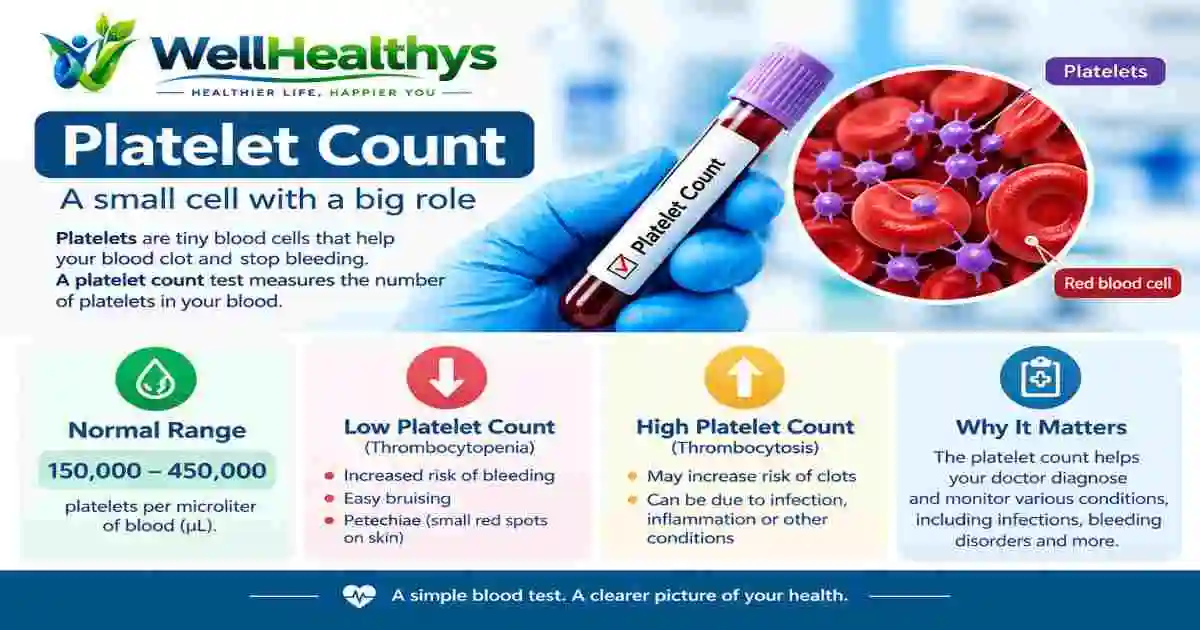
Platelets are small cell fragments in your blood. When a blood vessel is cut or damaged, platelets gather at the spot, stick together, and form a plug that stops the bleeding. This process is called blood clotting. Without enough platelets, small injuries can keep bleeding, and bruising and bleeding can appear with little or no reason.
A platelet count is a lab test that measures how many platelets are in a sample of your blood. It’s usually reported as part of a complete blood count (CBC), which also includes red cells, white cells, and haemoglobin. Doctors look at the platelet number alongside the rest of the report, not on its own.
One out-of-range result doesn’t always mean something serious. It does mean the number deserves a closer look, especially if it’s dropping over time or you have symptoms.
Normal platelet count range, and why your lab may differ

For most adults, MedlinePlus gives the normal platelet count range as 150,000 to 400,000 platelets per microlitre (µL). Some Indian labs print a slightly different upper limit, such as 450,000, which is why the reference range on your own report is the most accurate comparison for your result.
Labs differ for a few reasons. Each lab uses its own analysers and calibration, and reference ranges are set using samples from a particular group of people. Slight variation between labs is normal, and a value close to the edge of the range is often less important than whether it’s moving in one direction over several tests.
Before you worry about a number, check three things on your report: the reference range printed next to your result, the units, and the date of the test. A reading from six months ago is less useful than a fresh one that shows the trend.
Reading your report in Indian units

Many Indian lab reports show platelets in lakh platelet count format, such as “1.8 lakh.” One lakh equals 100,000, so you can convert any value by moving the decimal point five places to the right.
Here are some common values converted for you:
- 1 lakh = 100,000 per µL (low, below the normal range)
- 1.5 lakh = 150,000 per µL (lower limit of normal)
- 2.5 lakh = 250,000 per µL (within normal range)
- 4 lakh = 400,000 per µL (upper limit of normal)
- 4.5 lakh = 450,000 per µL (above the range used by some labs)
Some reports use another format, such as 150 x 10^9/L. This is the same value written in a different unit. 150 x 10^9/L equals 150,000 per µL, so the numbers match even though the notation looks different.
Low platelet count: causes and what they mean
A low platelet count, medically called thrombocytopenia, is a result below 150,000 per µL. It happens for three broad reasons: the bone marrow makes fewer platelets, the body destroys platelets faster than they’re made, or the spleen holds on to more platelets than usual.
Common triggers include viral infections, some medicines, autoimmune conditions where the immune system attacks platelets, and certain blood or liver conditions. Pregnancy and heavy alcohol use can also lower the count in some people. The cause matters more than the number alone, and a doctor usually considers the full blood count and how the value has changed over time.
If your count is low but you feel well and have no bleeding, your doctor may simply recheck it in a few days or weeks. If it’s low and you have symptoms, the next step is a more detailed evaluation. For a broader look at how conditions like this are grouped, browse our health conditions section.
High platelet count: causes and what it means
A high platelet count, medically called thrombocytosis, is a result above 400,000 per µL (or above the upper limit on your lab’s report). In many people, the raised count is a reaction to something else. Infection, inflammation, iron deficiency, and recovery from surgery or bleeding can all push the number up for a while.
Less often, a high count is linked to a bone marrow condition that needs specific treatment. The main concern with a high count is clotting, because too many platelets can make it easier for clots to form inside the blood vessels. Many people with a raised count feel completely well and never notice anything at all.
If your result is high, your doctor will want to know whether you have any inflammation, recent illness, or iron deficiency. Often, treating the underlying cause brings the number back down.
Dengue and platelet count: what to watch for
A dengue platelet count often falls during dengue, which is why many people search for this topic during the monsoon. Doctors don’t rely on a single reading. They watch the trend over several days, along with how the patient looks and feels. You can read the WHO’s overview of the illness in its dengue fact sheet.
Certain signs need urgent medical care rather than home monitoring. These include severe abdominal pain, repeated vomiting, bleeding from the gums or nose, blood in vomit, black or bloody stools, restlessness, unusual sleepiness, and dizziness when standing. If you or someone you’re looking after shows any of these, go to a hospital without delay.
Avoid taking aspirin or ibuprofen for dengue fever unless a doctor specifically advises it, because these medicines can increase bleeding risk. Ask a doctor or pharmacist before taking any painkiller during a suspected dengue illness. Follow the advice of the National Vector Borne Disease Control Programme for current testing and treatment guidance.
When the count might be wrong: lab artifacts and rechecks
Sometimes a platelet count looks lower than it really is because the platelets have clumped together in the sample tube. This is called pseudothrombocytopenia, and it’s a known laboratory effect rather than a true drop in platelets.
When a result looks unexpected, a doctor may ask the lab to check the sample under a microscope or repeat the platelet count test using a different tube type. A repeat test is a normal step in the process, and it doesn’t mean something has gone wrong with your health. It’s simply a way to confirm the number before making decisions.
If your doctor asks you to come back for a recheck, take it seriously and keep the appointment. Trends are often more useful than a single result.
Symptoms and urgency: when to see a doctor today
Not every symptom needs the same response. Here is a practical way to think about it.
Seek same-day medical care if you have any of the following:
- Bleeding that’s heavy or won’t stop
- Bleeding from the gums or nose that keeps coming back
- Blood in your urine or stools, or black, tarry stools
- A severe headache, confusion, or fainting
- Fever together with bleeding, or any bleeding during a dengue illness
Book a doctor’s visit within a few days if you notice:
- Frequent bruising that appears without a clear reason
- Tiny red or purple dots on the skin, called petechiae
- Bleeding that takes longer than usual to stop after small cuts
- Heavier menstrual periods than normal
Ask about a routine follow-up if you have a mild, unexplained change in an otherwise well person with no symptoms.
For any emergency, call 108 or 112 right away.
Platelet count in children, pregnancy, and older adults
Normal ranges can vary with age, so a child’s report should be read by a doctor who knows the child’s history. A result that’s slightly outside the adult range may be perfectly normal for a young child, and a doctor will look at the whole picture before deciding what to do.
Pregnancy can change platelet levels. Some mild changes are common and harmless, but any abnormal result should be discussed with the obstetric team, especially if you have bleeding, bruising, or a sharp drop from a previous test.
Older adults often take several medicines, and some of those can affect platelets. If your count is abnormal, your doctor will want a full list of your medicines and supplements, including anything bought over the counter.
Natural ways to support platelets: what the evidence says
Searches for “how to increase platelet count naturally” are common, and many articles online make strong claims about juices, leaves, and supplements. The honest picture is less exciting. The most reliable steps are treating the underlying cause, reviewing your medicines with a doctor, and following the treatment your doctor recommends.
Some home remedies have been studied, but the evidence is limited and often based on small trials. Papaya leaf extract, for example, has been discussed for dengue, though larger, well-designed studies are still needed before doctors can recommend it confidently. Remedies like these should never replace medical care, and they shouldn’t be used to delay a visit when your count is low.
A balanced diet supports your overall health, which in turn supports your body’s ability to make blood cells. For everyday nutrition basics, see our general nutrition guidance, but don’t expect a particular food to fix a low count on its own.
Questions to ask your doctor and next steps
Bring your full report to your appointment, not just the platelet number. Keeping copies of past reports helps your doctor see the trend, and it’s easy to do with a simple folder or a photo saved on your phone. Building good everyday health habits also makes it easier to notice changes early.
Useful questions to ask include: What do you think is causing this result? Do I need a repeat test, and when? Which symptoms should I watch for? Are any of my medicines or supplements affecting my platelets? What should I do if I start to bleed or bruise more than usual?
Your doctor may order additional tests, such as a peripheral blood smear, to look at the platelets under a microscope. They may also ask about recent infections, travel, or medicines, since these often explain a change.
Frequently asked questions
Is a platelet count of 1.2 lakh dangerous?
A count of 1.2 lakh, which is 120,000 per µL, is below the usual normal range of 150,000 to 400,000. Many people with a count in this range have no symptoms and aren’t in immediate danger. The next step is a doctor’s review to find out why the count is low and whether it’s changing over time.
Can I donate blood if my platelet count is low?
Blood donation rules depend on your overall health and your count, and blood banks set their own criteria. Ask the blood bank or your doctor before donating, since a low count can affect your ability to recover safely after donating.
Does papaya leaf juice raise platelets?
Some studies have looked at papaya leaf extract, mostly in people with dengue, but the evidence is still limited and not strong enough to recommend it as a treatment. Don’t use it in place of medical care, and check with your doctor before taking any herbal product.
Platelet count kam ho to kya ghabraana chahiye?
Ghabrana nahi, lekin lapaarwahi bhi nahi. Ek report mein platelet count thoda kam aana kai baar repeat test se clear ho jaata hai. Doctor ko report dikhayein, woh trend aur symptoms dekh kar bataayenge ki aage kya karna hai.
1 lakh platelet count ka matlab kya hai?
1 lakh ka matlab hai 100,000 platelets per microlitre. Ye normal range (1.5 se 4 lakh) se kaafi kam hai, isliye doctor se milna zaroori hai. Lekin sirf ek number dekh kar ghabrane ke bajay poori report aur symptoms ke saath dekhein.
Dengue mein platelet count gir jaaye to kya karein?
Dengue mein platelet count ka gir jaana aam hai, lekin doctor roz ya kuch din ke gap par trend dekhte hain. Agar pet mein tez dard, baar-baar ulti, muh ya naak se khoon, ya bahut kamzori ho, to turant hospital jaayein. Bina doctor ki salaah ke aspirin ya ibuprofen na lein.
Final thoughts
A platelet count is a useful signal, but the number is only one part of the story. The reference range, the trend over time, your symptoms, and your overall health all shape what the result means. Most people who get an out-of-range result can work through it calmly with a doctor, and a repeat test is often the next sensible step.
Call to action
If your report shows a count outside the normal range, or you have bleeding or bruising you can’t explain, book an appointment with a doctor this week. Bring your full blood report and a list of your medicines.
Have a blood test you’d like us to explain? Suggest a topic through our Contact Us page, and we’ll consider it for an upcoming guide.
Medical disclaimer
This article is for general information only and doesn’t replace professional medical advice, diagnosis, or treatment. Thresholds, dengue guidance, and any dosing information should be confirmed with a qualified doctor or an official source before you act on them. If you have bleeding, severe symptoms, or are pregnant or caring for a child, consult a doctor promptly. For details on how we handle content, read our medical disclaimer.
