


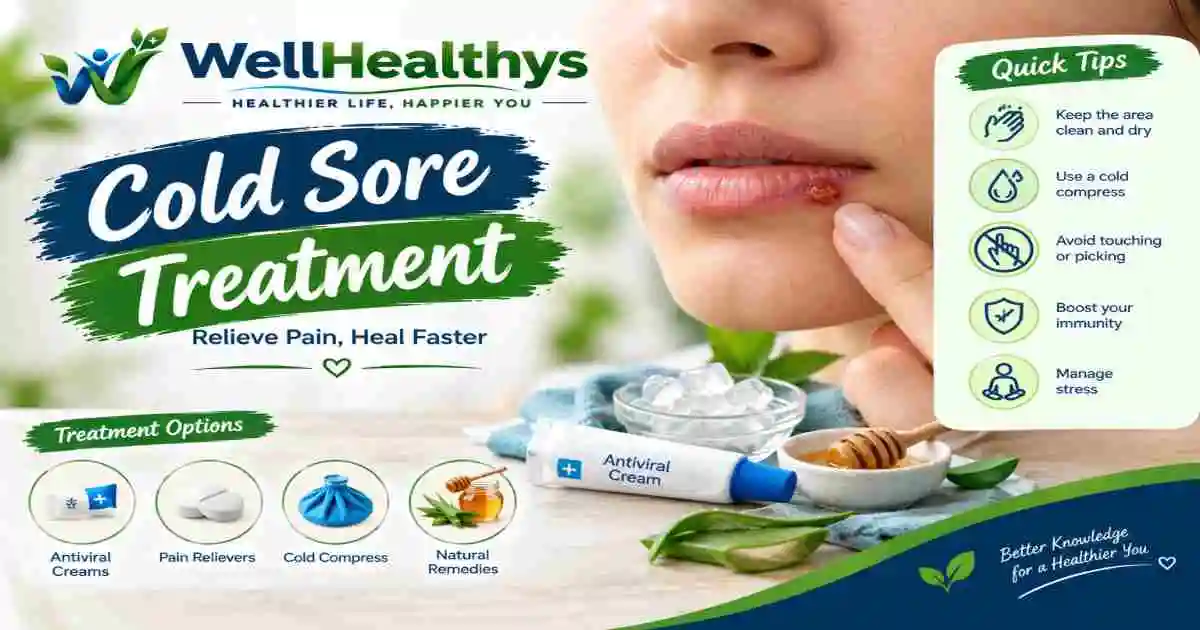
That telltale tingle on your lip is never good news. You know a blister is coming, and you’re already searching for a cold sore treatment that can stop it in its tracks, or at least get it over with faster.
WellHealthys pulled together what actually helps with a cold sore, what’s mostly just internet folklore, and how to tell a cold sore apart from something else entirely.
What Is a Cold Sore?
A cold sore, also called a fever blister, is a small, fluid-filled blister that usually shows up on or around your lips. According to Cleveland Clinic, it’s caused by the herpes simplex virus, most often type 1 (HSV-1), a virus that more than half of adults in the U.S. carry, even if they’ve never had a visible outbreak.
Once you’re infected, the virus stays in your body permanently, resting quietly in your nerve cells until something triggers it to reactivate. That’s why cold sores tend to show up again and again in the same spot, often at inconvenient times.
Cold Sore Stages: What to Expect

Knowing where you are in the cold sore stages helps you pick the right response at the right time.
- Tingling stage (6 to 24 hours before a blister appears). You’ll feel itching, burning, or tingling in one spot. This is your best window to start treatment.
- Blister stage. One or more small, fluid-filled blisters form, often surrounded by redness and swelling.
- Weeping stage. The blisters burst and ooze, which is when the sore is most painful and most contagious.
- Crusting stage. A scab forms over the sore as it starts to heal.
- Healing stage. The scab flakes off and the skin underneath heals, usually without scarring.
The whole cycle typically runs 7 to 10 days from the first tingle to fully healed skin.
Cold Sore vs. Canker Sore: What’s the Difference?

These two get mixed up constantly, but cold sore vs canker sore are not the same thing, and they don’t respond to the same treatments.
| Cold Sore | Canker Sore | |
| Location | Outside the mouth, on or around the lips | Inside the mouth, on the cheek or gums |
| Cause | Herpes simplex virus (contagious) | Not caused by a virus (not contagious) |
| Appearance | Fluid-filled blister, then crusts over | Shallow, round ulcer with a white or yellow center |
| Triggers | Stress, sun, illness, fatigue | Stress, acidic foods, minor mouth injury |
| Antiviral treatment | Works | Doesn’t work, since it’s not viral |
If your sore is inside your mouth rather than on the outer lip, you’re almost certainly dealing with a canker sore, and antiviral cold sore treatments won’t do anything for it.
Fastest Cold Sore Treatment Options

Start treatment the moment you feel tingling. This is the single biggest factor in how mild or severe an outbreak ends up being. Waiting until a blister has already formed means you’ve missed the window where cold sore treatment works best.
Over-the-counter antiviral cream. Docosanol, sold as Abreva, is the most common OTC option in the U.S. Applied at the first sign of tingling, it can modestly shorten how long the sore sticks around.
Prescription antivirals. For frequent, painful, or severe outbreaks, a doctor can prescribe oral antivirals like acyclovir, valacyclovir, or famciclovir. These tend to work better than topical creams, especially when started early.
Pain relief. Over-the-counter pain relievers like acetaminophen or ibuprofen can ease the swelling and discomfort while the sore runs its course. Numbing creams with lidocaine or benzocaine, often found in the dental care aisle, can also help with the pain, though they won’t make it heal faster.
It’s worth setting realistic expectations here: Healthline reports that research on how much antivirals actually speed healing shows a fairly modest effect, often shortening symptoms by less than a day. Starting early still matters, but no treatment makes a cold sore disappear overnight.
Home Remedies for Cold Sore Relief
These home remedies for cold sores won’t cure a cold sore, but they can make the healing process a lot more comfortable:
- Cold compress. A clean, damp cloth held against the sore for 5 to 10 minutes at a time helps numb pain and reduce swelling. Never apply ice directly to bare skin.
- Petroleum jelly. Keeps the area moisturized so it doesn’t dry out, crack, or bleed. Use a clean applicator each time rather than dipping fingers back into the jar.
- Aloe vera gel. Some studies suggest it calms inflammation, though it’s worth doing a patch test on your arm first in case of a reaction.
- Lysine-rich foods. Foods high in the amino acid lysine, like dairy, fish, and legumes, are sometimes suggested to support healing, though evidence is mixed. If stress is a recurring trigger for your outbreaks, our guide on the five stress levels might help you manage that side of things too.
- Manuka honey. A 2021 study found medical-grade Manuka honey performed comparably to standard treatments, though it needs a patch test first and shouldn’t be licked off, which defeats the purpose.
Be cautious with essential oils like tea tree oil. They’re sometimes marketed for cold sores, but applied incorrectly, they can irritate or burn already sensitive skin.
What Not to Do When You Have a Cold Sore

A few habits can make things worse or spread the virus further:
- Don’t pick, pop, or squeeze the blister, which can spread the virus to other parts of your face or delay healing
- Don’t share lip balm, drinks, towels, or utensils while you have an active sore
- Don’t kiss anyone, including babies and young children, until it’s fully healed
- Don’t apply a product straight from a jar or tube to the sore and then reuse it on other skin, since that contaminates the whole container
How Long Are Cold Sores Contagious?
Cold sores are contagious from the moment you feel that first tingle, all the way through until the skin has completely healed over, with no more scab. The weeping stage, when the blister has burst and is oozing, is when you’re most contagious, so that’s the point to be most careful about contact with others.
How to Prevent Cold Sore Outbreaks

Since the virus never fully leaves your body, prevention is really about managing your known triggers:
- Manage stress. Stress is one of the most commonly reported triggers for outbreaks.
- Protect your lips from sun exposure. A lip balm with SPF can help if sun is a trigger for you.
- Get enough sleep and support your immune system. Being run down or sick makes reactivation more likely.
- Notice your personal patterns. Some people find certain foods, hormonal changes, or specific situations tend to bring on an outbreak, and avoiding those triggers when possible can reduce how often they happen.
When to See a Doctor
Most cold sores can be managed at home, but check in with a doctor if:
- Outbreaks are frequent, severe, or don’t follow the usual healing timeline
- The sore hasn’t started healing after 2 weeks
- You have a weakened immune system and develop a cold sore
- The sore spreads near your eyes, which needs prompt attention to protect your vision
- You develop a fever, or the area becomes increasingly swollen, red, or warm, which can signal a secondary infection
Frequently Asked Questions
Can a cold sore go away overnight?
No. Even with early antiviral treatment, complete overnight healing isn’t realistic. Most cold sores take 7 to 10 days to fully resolve, though starting treatment right at the tingling stage can shorten that by a day or two.
Are cold sores the same as herpes?
Yes, cold sores are caused by the herpes simplex virus, most commonly HSV-1. This is different from the strain most associated with genital herpes (HSV-2), though either type can technically appear in either location.
Why do I keep getting cold sores in the same spot?
Once you’re infected, HSV-1 stays dormant in nearby nerve cells and tends to reactivate along the same nerve pathway, which is why outbreaks often recur in the same general area.
Does toothpaste help get rid of a cold sore?
There’s no solid evidence that toothpaste speeds healing, and some ingredients in toothpaste can actually irritate the already sensitive skin of a cold sore. Sticking to proven options like antiviral cream is a better bet.
Is it safe to cover a cold sore with makeup?
Once the sore has crusted over, some people do cover it with makeup, though it’s best to use a clean applicator and avoid sharing that product with anyone else. Avoid makeup during the earlier blister or weeping stages, since it can irritate the area further.
Getting Support with WellHealthys
A cold sore is uncomfortable and, let’s be honest, badly timed more often than not, but it’s rarely more than a temporary nuisance. Knowing which cold sore treatment options are actually worth your money, and which stages need the most care, can make the next week a lot more manageable.
At WellHealthys, we’ll keep sharing practical, no-nonsense guides for the everyday health questions that don’t always get a straight answer. Explore more in our Health and Wellness sections for related guides.
What to Do Next
- Start treatment now if you’re feeling that early tingle, don’t wait for a blister to form.
- Keep the area clean and moisturized, and resist the urge to pick at it.
- See a doctor if outbreaks are frequent, severe, or near your eyes.
- Subscribe to WellHealthys for more practical health guides like this one.
Medical Disclaimer
This article is for informational purposes only and is not a substitute for professional medical advice, diagnosis, or treatment. WellHealthys is not a healthcare provider. Always seek the advice of a qualified physician or dermatologist with any questions about cold sores or other skin conditions. Never disregard professional medical advice or delay seeking it because of something you have read here. If a sore spreads near your eyes or you notice signs of a serious infection, contact your doctor promptly.
About the Author
Written by Prashant Kashyap, Founder at WellHealthys. Prashant is not a licensed medical professional. He researches and compiles health information from established clinical sources, including Cleveland Clinic and Healthline, to help readers understand topics like cold sore treatment in plain, accessible language. This article should not replace advice from a qualified doctor.
