


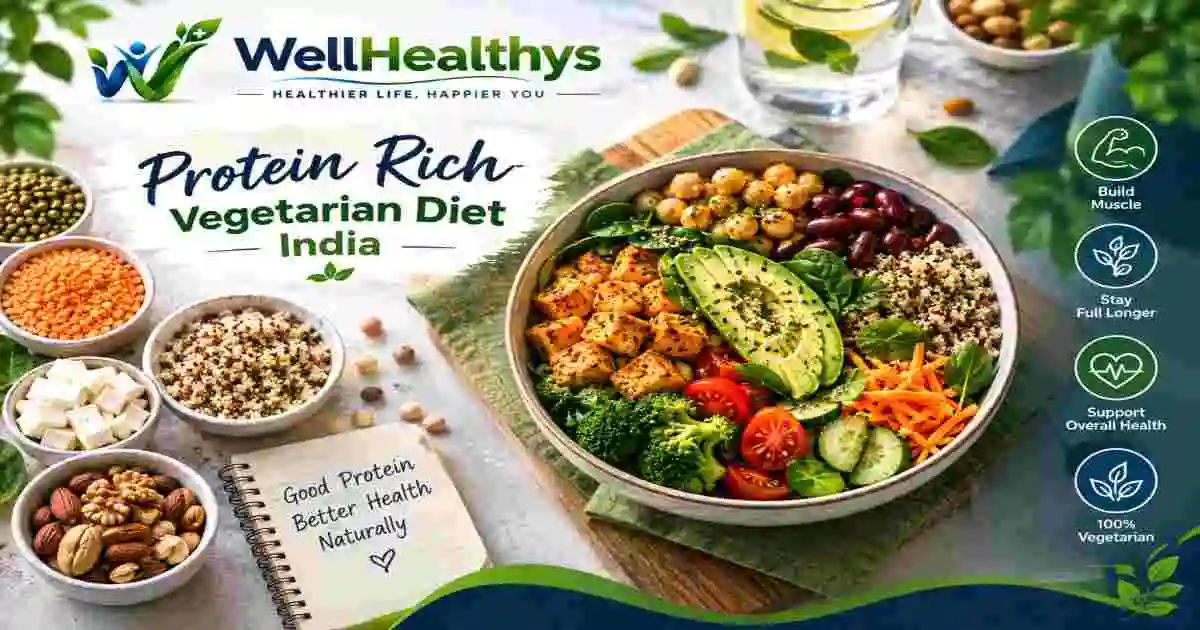
A friend of mine started going to the gym seriously last year and immediately assumed he’d need to start eating chicken to build any real muscle, despite being vegetarian his whole life. His trainer, also vegetarian, laughed and pulled up his own meal log, dal twice a day, a big bowl of curd, roasted chana as a snack, and a paneer-heavy dinner. Six months in, my friend had gained visible muscle without touching meat once. WellHealthys hears this same worry constantly, that a protein rich vegetarian diet India style approach is somehow harder to pull off than it actually is. It isn’t, once you know which foods carry the weight and how to combine them.
How Much Protein Do You Actually Need?
Before picking foods, it helps to know what number you’re actually aiming for, since “eat more protein” without a target is hard to act on.
For a sedentary or lightly active adult, roughly 0.8 to 1 gram of protein per kilogram of body weight per day covers basic needs, so a 60 kg person would aim for about 48 to 60 grams daily. If you’re strength training, trying to build muscle, or generally quite active, that target rises to 1.2 to 1.8 grams per kilogram, meaning the same 60 kg person might aim for 72 to 108 grams a day, a range that lines up with what most vegetarian protein sources for muscle gain guidance recommends.
ICMR-NIN’s Dietary Guidelines for Indians reflect similar baseline protein recommendations for the general population. Pregnant or breastfeeding women and growing teenagers also typically need more than the baseline, though exact numbers are worth confirming with a doctor or dietitian. Our muscle building guide has more on structuring intake if strength training is your goal.
Ranked List: Best Vegetarian Protein Sources in India (By Protein Content)

Here’s a comparison table of high protein vegetarian foods India households already have easy access to, ranked by protein content per typical serving, which makes it much easier to prioritize than a scattered list.
| Food | Serving | Protein (approx.) |
| Soy chunks (dry) | 100g | 52g |
| Paneer | 100g | 18g |
| Moong dal (cooked) | 1 cup | 18g |
| Peanuts | 100g | 25g |
| Tofu | 100g | 8g |
| Chickpeas (boiled) | 100g | 9g |
| Greek yogurt | 200g | 20g |
| Rajma (kidney beans, cooked) | 1 cup | 15g |
| Quinoa (cooked) | 1 cup | 8g |
| Milk | 250ml | 8g |
| Almonds | 30g (small handful) | 6g |
| Oats | 100g | 13g |
Soy chunks and peanuts often surprise people, they’re among the cheapest, highest-protein options available in any Indian kitchen, yet they rarely top these lists the way paneer does.
Complete Protein Combos: Getting All Essential Amino Acids
Here’s a detail most articles gloss over in a single line, and it’s central to building a genuine complete protein vegetarian diet. Plant proteins, unlike most animal proteins, often lack one or more essential amino acids on their own, which is where smart combining matters.
Dal and rice together form a genuinely complete protein, the amino acids missing in lentils are present in rice, and vice versa, which is exactly why this combination has been a staple across Indian households for centuries, not by accident.
Roti and dal work the same way, wheat and lentils complement each other’s amino acid gaps. Chana and til (sesame seeds) is another solid pairing, commonly found in traditional chikki or laddoo. You don’t need to obsess over pairing every single meal perfectly, eating a reasonably varied diet across the day naturally covers most amino acid gaps without much conscious effort.
A Quick Note on Plant Protein Absorption
This is worth knowing honestly rather than glossing over, since it changes how you should think about your daily target.
Plant proteins are generally slightly less digestible than animal proteins, measured by scores like DIAAS, meaning your body absorbs a somewhat smaller percentage of the protein you eat from sources like dal or chickpeas compared to paneer or milk.
This isn’t a reason to worry, but it’s a reason to aim a little higher than the bare minimum if you’re relying heavily on legumes and grains rather than dairy or soy. Practically, this just means treating the low end of your target range as a floor, not a ceiling, especially if dairy and soy make up a small part of your diet.
Protein Sources Beyond North India: Regional Options
Most protein content online defaults to North Indian staples, dal, paneer, roti, but vegetarian protein looks different depending on where you’re eating.
In South Indian cooking, the naturally fermented batter used for idli and dosa combines rice and urad dal, giving it a similar complete-protein benefit to dal-rice combinations, and sambar adds another layer of lentil protein to the meal. Gujarati cuisine offers dhokla and khaman, both made from besan (chickpea flour), a genuinely protein-dense base most people don’t think of as a protein source.
Bengali vegetarian cooking leans on chana dal and paneer-based sweets like sandesh, which double as a protein source in a way that’s easy to overlook. The point isn’t to switch cuisines, it’s to recognize that whatever regional food culture you already eat likely has strong protein options built in. Our Women’s Health section covers more on nutrition needs that vary across life stages and family diets.
A Full Day Protein Rich Vegetarian Diet India Meal Plan (With Running Total)

Seeing how protein adds up across an actual day is more useful than any single food list, so here’s a realistic example totaling around 75 grams.
Breakfast: a bowl of moong dal chilla with curd (about 20g). Mid-morning snack: a small handful of roasted chana (about 8g). Lunch: two rotis, a katori of rajma, and a small bowl of curd (about 22g). Evening snack: a glass of milk with a handful of peanuts (about 15g). Dinner: paneer bhurji with one roti and a side of sautéed vegetables (about 18g). That’s roughly 83 grams across the day, comfortably covering an active adult’s target without any protein powder or unusual ingredients, just regular Indian home food eaten with a bit of intention.
Budget-Friendly Protein: Best Value Per Rupee
Protein doesn’t have to be expensive, and among the best protein foods for vegetarians in India, some of the cheapest options are also the most protein-dense.
Soy chunks and various dals are consistently among the most affordable protein sources by weight, often costing a fraction of paneer or nuts for a comparable amount of protein. Eggs, for those who include them, and seasonal legumes like chana and rajma also offer strong value. Nuts and paneer, while nutritious, tend to be the pricier end of the spectrum, worth including for variety but not necessary as your primary daily source if budget is a real constraint. Building a diet around dal, soy chunks, and seasonal legumes, with paneer or nuts as an occasional addition, keeps both cost and protein intake in a good place.
Whole Foods vs Protein Powder: Do Vegetarians Need Supplements?
This question comes up constantly, and the honest answer is that it depends more on your specific situation than most marketing suggests.
For most people eating a varied, intentional vegetarian diet, whole foods alone can comfortably meet even elevated protein targets, as the meal plan above shows. Protein powder becomes genuinely useful in specific situations, very high training volume where hitting 100g plus daily through food alone feels impractical, a busy schedule that makes regular home-cooked meals difficult, or a smaller appetite that makes eating enough whole food volume a challenge. It’s a convenience tool, not a requirement, and whole foods bring fiber, micronutrients, and satiety that a scoop of powder doesn’t replicate. Our Nutrition section has more on building a complete, sustainable diet around whichever approach fits your life.
Frequently Asked Questions
Can vegetarians build muscle without protein powder?
Yes. A well-planned vegetarian diet with enough dal, paneer, soy, and dairy can comfortably meet the protein needs of muscle building, as many vegetarian athletes and bodybuilders in India demonstrate regularly.
What are the best vegetarian protein sources for weight loss?
Paneer, tofu, Greek yogurt, and legumes work particularly well for weight loss since they’re high in protein and fiber relative to their calories, helping you feel full on fewer calories overall.
Is paneer or tofu better for protein?
Paneer has more protein per 100g and more calcium, while tofu is lower in saturated fat and calories. Neither is universally “better,” the right choice depends on your overall calorie and fat goals.
How much dal should I eat daily for protein?
A cup of cooked dal provides roughly 15 to 18 grams of protein, so including it once or twice daily alongside other protein sources like dairy or soy comfortably contributes to most people’s daily targets.
Do vegetarians really lack protein compared to non-vegetarians?
Not inherently. With intentional food choices, vegetarians can meet the same protein targets as non-vegetarians, though it does require a bit more awareness of food combining and portion sizes compared to relying on meat alone.
Vegetarian diet mein protein kaise badhayein?
Dal, paneer, soya chunks, curd, aur nuts ko roz ke meals mein consistently shamil karke protein badhaya ja sakta hai. Dal-chawal ya roti-dal jaisa combination complete protein bhi deta hai.
Kya sirf dal khane se poora protein mil jata hai?
Sirf dal se kaafi protein milta hai, lekin isse chawal ya roti ke saath khana better hai kyunki dono milkar complete amino acid profile dete hain jo akele dal nahi deti.
Vegetarian bodybuilders muscle kaise banate hain bina meat ke?
Paneer, soya chunks, dal, dairy, aur nuts ka sahi combination lekar, roz ka protein target (1.2-1.8g per kg active logo ke liye) consistently poora karke vegetarian bodybuilders bhi achi muscle build kar sakte hain, jaisa India mein kai athletes ne prove kiya hai.
The Bottom Line
A protein rich vegetarian diet in India isn’t a challenge that requires exotic ingredients or expensive supplements, it requires knowing which everyday foods carry real protein weight and combining them with a little intention. Dal, paneer, soy, legumes, and dairy, eaten consistently across the day, comfortably cover most people’s needs, whether the goal is building muscle, managing weight, or simply eating well.
About the Author
Prashant Kashyap is the founder of WellHealthys, a health and wellness platform focused on practical, easy-to-follow guidance on fitness, nutrition, mental wellness, and everyday healthy living. He writes with the goal of turning research-backed health information into simple habits real people can actually stick to.
Disclaimer
The information in this article is for general educational purposes only and is not intended as medical or dietary advice. Individual protein needs vary based on age, health conditions, and activity level. Please consult a doctor or registered dietitian for personalized nutrition guidance, especially if you have an existing health condition.
