


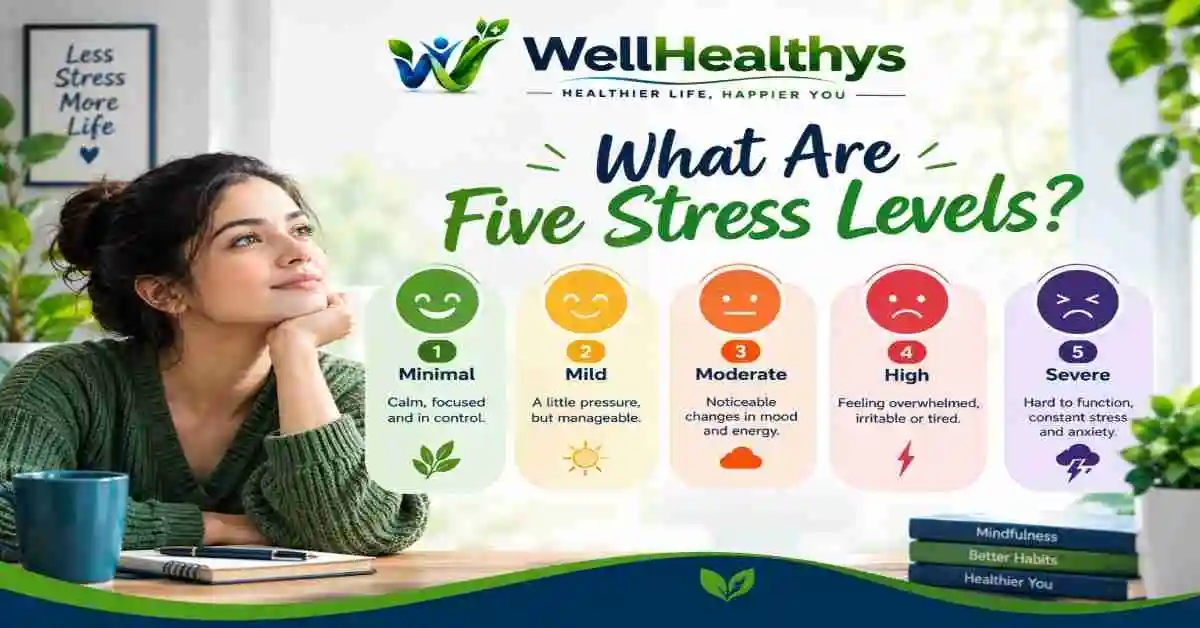
A friend of mine, a nurse working rotating night shifts, once described her stress like a dimmer switch rather than an on-off button. Some weeks she was at a low hum she barely noticed. Other weeks, usually around understaffed holiday shifts, she’d notice her jaw clenching, her sleep falling apart, and her patience running out by mid-shift. She didn’t have a name for these different states until a workplace wellness session introduced her to a simple five-level way of thinking about stress intensity. WellHealthys wants to walk through that same framework here, because understanding what are five stress levels genuinely helps you catch problems before they compound, as long as you understand what this framework actually is and isn’t.
What Are Five Stress Levels, Really? (A Quick Clarification)

Here’s something worth knowing upfront that most articles on this topic skip. There isn’t one single, universally standardized clinical model called “the five stress levels.” What you’ll find across psychology, workplace wellness programs, and self-help resources are several similar frameworks, all describing stress intensity on a spectrum from mild to severe, usually in five rough tiers.
This matters because treating it as a rigid diagnostic scale would be misleading. Instead, think of it as a practical mental model, similar to how a pain scale of one to ten helps you communicate discomfort even though it isn’t a lab test. The version used most often, and the one this guide follows, breaks stress into Low, Moderate, Elevated, High, and Severe or Chronic stress. Each level reflects a genuine, observable difference in how your body and mind respond under pressure. Our Mental Health section covers related concepts in more depth if you want the broader picture.
Level 1, Low Stress (The Baseline)
At this level, your nervous system is doing what it’s supposed to do, responding to normal daily demands without tipping into overwhelm.
You’re able to think clearly, make decisions without excessive second-guessing, and handle minor setbacks, a missed bus, a tight deadline, without much lingering effect. Sleep stays fairly consistent, and appetite doesn’t swing dramatically. This is actually a productive zone, a small amount of stress sharpens focus and motivation rather than undermining it. The goal isn’t to eliminate stress entirely, since a completely stress-free life isn’t realistic or even desirable, it’s to recognize this baseline so you notice when you’ve drifted away from it. Regular movement, something our Fitness section covers in more depth, is one of the simplest ways to stay anchored here.
Level 2, Moderate Stress
This is where most working adults spend a good chunk of their week, and it’s the level most people underestimate.
Stress becomes noticeable here, a demanding project, a difficult conversation you’re dreading, financial pressure that’s manageable but present. You might notice mild tension, slightly disrupted focus, or a shorter fuse than usual. The key difference from Level 1 is that moderate stress requires some active coping, even if it’s small, a short walk, stepping away from your desk, or just naming what’s bothering you. Left unaddressed for weeks at a time, moderate stress has a way of quietly sliding into the next level without an obvious turning point.
Level 3, Elevated Stress
Here, stress starts visibly interfering with how you function, not just how you feel.
Sleep becomes harder to protect, either trouble falling asleep or waking up in the middle of the night with your mind racing. Concentration takes a real hit, and irritability shows up in ways that surprise the people around you, and sometimes yourself. Physically, this is often where people notice tension headaches, a tight jaw, or shoulders that never quite relax. Elevated stress is usually tied to a specific, ongoing source, a demanding season at work, a family situation, an unresolved conflict, and it tends to ease once that source resolves or you actively intervene.
Level 4, High Stress
This level is where the effects become harder to ignore and genuinely start affecting your health, not just your mood.
Decision-making noticeably suffers, small choices feel disproportionately difficult, and you might find yourself avoiding tasks rather than tackling them. Physical symptoms intensify, digestive issues, frequent headaches, a racing heart in situations that wouldn’t normally trigger one. Sleep is often significantly disrupted by this point, which compounds everything else, since poor sleep itself makes stress harder to regulate. This is the level where active intervention, whether that’s structural changes to your workload, talking to someone, or professional support, starts to matter more than simple self-care tips.
Level 5, Severe or Chronic Stress
This is the level with the most solid research behind it, and it’s worth taking the signs of chronic stress seriously rather than treating them as just “really stressed.”
Sustained high stress keeps cortisol, your body’s primary stress hormone, elevated over long periods, and research on allostatic load has linked this kind of chronic elevation to measurable changes, including altered immune function and effects on areas of the brain involved in memory and emotional regulation. This isn’t a vague claim, it reflects real findings in neuroendocrinology and stress research built up over decades. At this level, people often describe feeling persistently exhausted even after rest, emotionally numb or overwhelmed, and physically run down in ways that don’t resolve with a weekend off. This is also the level most closely associated with burnout and a genuinely increased risk for other health conditions over time.
How Do You Know Which Level You’re At?

This isn’t a diagnostic quiz, but checking a few stress level symptoms honestly helps you locate yourself on the spectrum.
Ask yourself how your sleep has been over the past two weeks, not just last night. Notice whether small frustrations are triggering outsized reactions compared to how you’d normally respond. Pay attention to whether you’re using unhealthy coping patterns, like skipping meals, drinking more than usual, or withdrawing from people you’d normally talk to. None of these alone means much, but a cluster of them, persisting for weeks rather than days, usually signals you’ve moved up a level or two from where you’d like to be.
Evidence-Based Ways to Manage Each Level
Learning how to manage stress levels effectively starts with recognizing that different levels genuinely call for different responses, and applying a Level 1 strategy to Level 4 stress rarely works.
For low and moderate stress, small, consistent habits do most of the work, regular movement, protecting sleep, and brief breaks during demanding periods. For elevated stress, more structural changes help, actually addressing the source where possible, and building in recovery time rather than just pushing through. For high and severe stress, self-help strategies alone often aren’t enough, this is where therapy, medical support, or significant lifestyle restructuring genuinely becomes necessary rather than optional. Our Wellness section has more on building sustainable stress-management habits for the lower levels of this spectrum.
When Stress Becomes a Medical Concern

Some signs suggest it’s time to involve a professional rather than continuing to self-manage.
Persistent physical symptoms, chest tightness, ongoing digestive problems, or headaches that don’t respond to rest, deserve a doctor’s attention rather than being written off as “just stress.” Similarly, if stress is affecting your ability to function at work, in relationships, or in daily tasks for more than a few weeks, or if you notice signs of depression or anxiety layered on top of the stress itself, a mental health professional can help in ways self-directed strategies can’t. Our Diseases & Conditions section has more on recognizing when a symptom needs medical evaluation.
Frequently Asked Questions
Is there an official five stress levels model?
Not a single universally standardized one. Several similar frameworks exist across psychology and workplace wellness resources, all describing stress intensity in roughly five tiers, but no single body has established one official version.
What’s the difference between stress and anxiety?
Stress is typically a response to an external pressure or demand and tends to ease once that pressure resolves. Anxiety often persists even without a clear external trigger and can involve more chronic worry or physical symptoms unrelated to a specific stressor.
Can stress levels change quickly?
Yes, stress can shift within hours depending on circumstances, a resolved conflict or a completed deadline can bring you down a level fairly fast. Chronic stress that’s built up over months, however, usually takes longer and more deliberate effort to come down from.
How long does chronic stress take to affect health?
Research suggests measurable physiological changes, including altered cortisol patterns, can begin within weeks of sustained high stress, though the more serious long-term health effects tend to develop over months to years of unaddressed chronic stress.
What’s the fastest way to lower stress in the moment?
Slow, deep breathing for a few minutes is one of the most immediately effective tools, since it directly activates your parasympathetic nervous system. It won’t resolve chronic or severe stress on its own, but it reliably takes the edge off an acute spike.
Stress ke 5 levels kya hote hain?
Stress ke 5 levels aam taur pe Low, Moderate, Elevated, High, aur Severe (Chronic) hote hain. Ye ek practical framework hai, koi fixed clinical standard nahi, jo stress ki intensity ko samajhne mein help karta hai.
Chronic stress ke kya symptoms hote hain?
Chronic stress mein persistent thakan (rest ke baad bhi), emotional numbness ya overwhelm, aur physical symptoms jaise headaches ya digestive issues shamil hain jo weekend off lene se bhi theek nahi hote.
Stress aur anxiety mein kya farak hai?
Stress usually ek external pressure ka response hota hai aur pressure khatam hote hi kam ho jata hai. Anxiety often bina kisi clear trigger ke bhi bana rehta hai aur zyada chronic worry ya physical symptoms ke saath aata hai.
Kya stress level jaldi change ho sakta hai?
Haan, stress kuch ghanton mein bhi change ho sakta hai depending on circumstances, jaise ek resolved conflict ya complete hui deadline aapko ek level neeche la sakti hai. Lekin mahino se build hui chronic stress ko kam hone mein zyada time aur deliberate effort lagta hai.
The Bottom Line
Understanding what are five stress levels gives you a practical way to notice where you actually are, rather than just labeling everything “stressed” and hoping it passes. The framework isn’t an official clinical scale, but the underlying idea, that stress intensity exists on a spectrum requiring different responses at different points, is genuinely useful and backed by real research at the more severe end.
About the Author
Prashant Kashyap is the founder of WellHealthys, a health and wellness platform focused on practical, easy-to-follow guidance on fitness, nutrition, mental wellness, and everyday healthy living. He writes with the goal of turning research-backed health information into simple habits real people can actually stick to.
Disclaimer
The information in this article is for general educational purposes only and is not intended as medical or psychological advice. It should not be used to diagnose any condition and is not a substitute for evaluation by a licensed mental health professional. If stress is significantly affecting your daily life, please consider speaking with a doctor or therapist.

1 Comment
Pingback: Cold Sore Treatment: 5 Fast Options | WellHealthys