


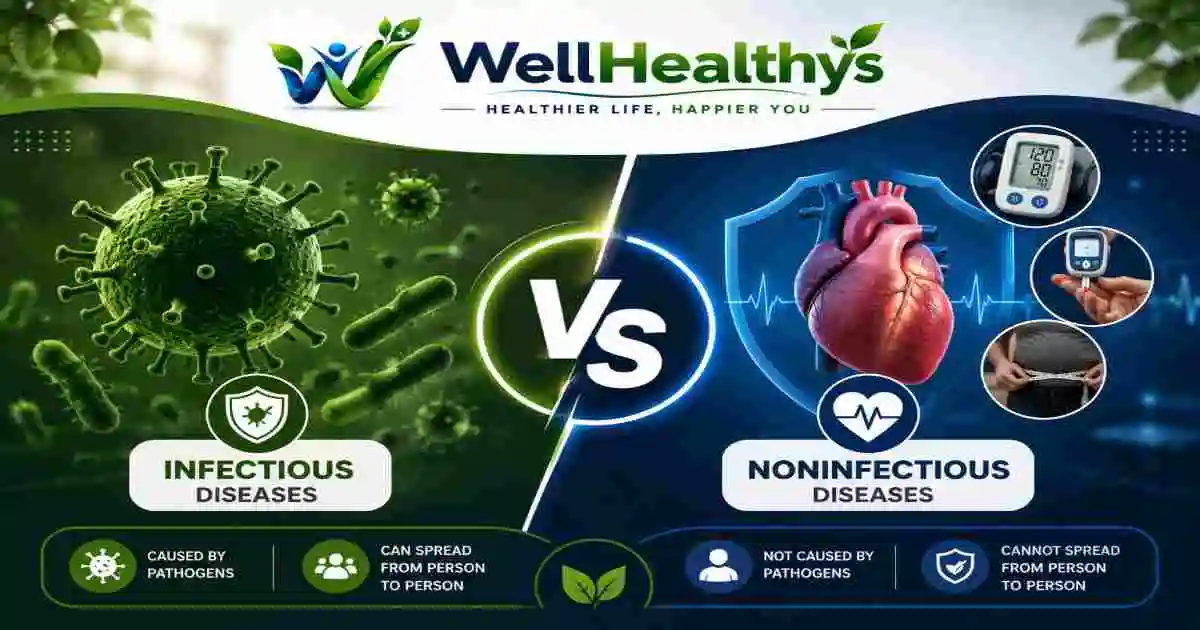
When my nephew came home from school last month with a stomach bug that had gone around his entire classroom, his grandmother had a very different reaction than when his grandfather was diagnosed with type 2 diabetes a few years earlier. One meant keeping him home and disinfecting shared spaces. The other meant a lifetime of managing diet and medication with zero risk to anyone else in the house. That difference, whether a disease can jump from one person to another, is exactly the difference between infectious and noninfectious diseases, and it’s a distinction WellHealthys sees people mix up constantly, even though it changes everything about how a disease is prevented and treated.
What Makes a Disease “Infectious”?
An infectious disease is caused by a pathogen, a microorganism like bacteria, viruses, fungi, or parasites, that invades the body and disrupts normal function. The defining feature is that pathogens can move from one host to another, which is why these diseases are also called communicable or contagious.
Transmission, or how infectious diseases spread, happens in several ways. Some pathogens spread through the air when someone coughs or sneezes, like influenza. Others spread through direct contact or bodily fluids, like hepatitis. Some travel through contaminated food or water, like typhoid, and others need a carrier like a mosquito, which is how dengue and malaria spread across large parts of India every monsoon season. Common infectious diseases you’ve probably encountered include the common cold, tuberculosis, COVID-19, and chickenpox.
What Makes a Disease “Noninfectious”?
A noninfectious disease, often called a noncommunicable disease, isn’t caused by a pathogen and cannot spread from person to person no matter how much contact occurs. The main causes of noninfectious diseases are a mix of genetics, lifestyle choices, environmental exposure, or the natural process of aging.
Diabetes, hypertension, asthma, and most cancers fall into this category, and in India specifically, lifestyle-related noninfectious diseases like diabetes and heart disease have been rising sharply as diets and daily routines shift toward less physical activity and more processed food, a trend WHO’s global data on noncommunicable diseases also confirms worldwide. Unlike an infection, you can spend as much time as you want around someone with a noninfectious disease without any risk of catching it yourself. Our Nutrition section has more on how diet choices tie into long-term disease risk.
Difference Between Infectious and Noninfectious Diseases (Comparison Table)

Here’s a clean side-by-side breakdown that makes the distinction easy to hold onto, whether you’re studying for an exam or just trying to understand a diagnosis.
| Factor | Infectious Diseases | Noninfectious Diseases |
| Cause | Pathogens (bacteria, viruses, fungi, parasites) | Genetics, lifestyle, environment, aging |
| Spreads Between People | Yes | No |
| Typical Duration | Often short-term, though some become chronic | Usually long-term or chronic |
| Common Examples | Flu, tuberculosis, dengue, malaria, COVID-19 | Diabetes, hypertension, asthma, most cancers |
| Main Treatment Approach | Antibiotics, antivirals, antifungals, supportive care | Lifestyle changes, ongoing medication, symptom management |
| Prevention Focus | Vaccination, hygiene, safe food and water | Diet, exercise, avoiding tobacco, regular screening |
When the Line Blurs: Infections That Cause Noninfectious Diseases

Here’s something most explanations of this topic skip entirely, and it genuinely surprises a lot of people the first time they hear it. Some diseases we classify as noninfectious actually start with an infection.
H. pylori, a bacteria that infects the stomach lining, is a leading cause of stomach cancer, a disease we normally file under “noninfectious.” Human papillomavirus, or HPV, a sexually transmitted infection, is responsible for the vast majority of cervical cancer cases worldwide. Hepatitis B and C, both infectious viral diseases, are major causes of liver cancer and cirrhosis over time. In each of these cases, the infection itself is contagious, but the long-term disease it triggers, cancer, isn’t something you can catch from another person.
This matters practically too. It’s part of why vaccines like the HPV vaccine and Hepatitis B vaccine are now framed as cancer-prevention tools, not just infection-prevention tools. Understanding this overlap gives a more complete picture than treating the two categories as entirely separate boxes.
Prevention: Same Goal, Different Playbook

Preventing disease matters either way, but the actual playbook looks different depending on which category you’re dealing with.
For infectious diseases, prevention centers on stopping the pathogen from reaching you or spreading further. That means vaccination where available, consistent handwashing, safe drinking water, properly cooked food, and using mosquito protection in dengue or malaria-prone areas. For noninfectious diseases, prevention is about reducing long-term risk factors. That means a balanced diet with less processed food and sugar, regular physical activity, avoiding tobacco and excessive alcohol, and getting recommended health screenings that can catch conditions like high blood pressure or early-stage cancer before symptoms even appear. Our Wellness section has more practical guidance on building these habits into daily life.
Treatment: Why “Cure” Means Something Different for Each
Treatment approaches diverge sharply between the two categories, and understanding why helps explain a lot about how doctors approach each type of illness.
Infectious diseases are often treatable with medication that directly targets the pathogen, antibiotics for bacterial infections, antivirals for certain viral infections, and antifungals for fungal infections. Many infectious diseases can be fully cured once the pathogen is cleared from the body. Noninfectious diseases work differently. There’s rarely a pathogen to eliminate, so treatment usually focuses on long-term management rather than a cure, controlling blood sugar in diabetes, managing blood pressure with medication and diet, or using inhalers to control asthma symptoms. Some noninfectious conditions can be significantly improved or even reversed with sustained lifestyle changes, but “cure” isn’t always the right framework to begin with.
Symptoms Overlap, So How Do Doctors Tell the Difference?
Fever, fatigue, pain, and weight loss can all show up in both infectious and noninfectious diseases, which is exactly why self-diagnosis based on symptoms alone is unreliable.
Doctors rely on a combination of medical history, physical examination, and lab tests to pin down the actual cause. Blood tests can detect pathogens or antibodies for infections, while imaging and other diagnostic tools help identify noninfectious conditions like tumors or organ damage. This is also why two people with what feels like the same symptoms can walk out of a clinic with completely different diagnoses, and completely different treatment plans. Our Diseases & Conditions section covers more on how specific conditions are identified and managed.
Quick Recap for Students
If you’re revising this for an exam, here’s a quick set of infectious vs noninfectious diseases examples and the core distinction condensed into a few lines you can memorize quickly.
Infectious diseases are caused by pathogens, spread between people, and are usually treated by targeting the pathogen directly. Noninfectious diseases are caused by genetics, lifestyle, or environment, don’t spread between people, and are usually managed long-term rather than cured outright. A few infections, like HPV and Hepatitis B, can also lead to noninfectious diseases like cancer later on, which is a detail worth remembering for a more complete answer.
Frequently Asked Questions
What is the main difference between infectious and noninfectious diseases?
Infectious diseases are caused by pathogens and can spread from person to person, while noninfectious diseases are caused by factors like genetics or lifestyle and cannot spread between people.
Can noninfectious diseases become infectious?
No, a noninfectious disease itself doesn’t become contagious. However, some noninfectious diseases like certain cancers can actually be triggered by an earlier infectious disease, such as HPV leading to cervical cancer.
Are all infectious diseases contagious?
Most are, but not all spread directly from person to person. Some, like malaria or tetanus, are acquired from a source like a mosquito or contaminated environment rather than direct human contact.
What are 5 examples of infectious diseases and 5 examples of noninfectious diseases?
Infectious diseases include the flu, tuberculosis, dengue, malaria, and COVID-19. Noninfectious diseases include diabetes, hypertension, asthma, most cancers, and arthritis.
Can lifestyle diseases be cured completely?
Some can be significantly reversed with sustained lifestyle changes, particularly early-stage type 2 diabetes, but many noninfectious diseases are managed long-term rather than fully cured.
Infectious aur noninfectious diseases mein kya farak hai?
Infectious diseases pathogens (bacteria, virus) se hoti hain aur ek insaan se doosre insaan mein fail sakti hain, jabki noninfectious diseases genetics, lifestyle ya environment ki wajah se hoti hain aur fail nahi sakti.
Kya noninfectious disease infectious ban sakti hai?
Nahi, noninfectious disease khud contagious nahi banti. Lekin kuch cases mein ek infectious disease baad mein noninfectious disease ka cause ban sakti hai, jaise HPV infection cervical cancer ka cause banta hai.
Infectious diseases ke kya examples hain?
Flu, tuberculosis (TB), dengue, malaria, aur COVID-19 common infectious diseases hain jo India mein aksar dekhe jaate hain.
Noninfectious diseases ke kya examples hain?
Diabetes, hypertension (high blood pressure), asthma, zyadatar cancers, aur arthritis common noninfectious diseases hain jo lifestyle aur genetics se juri hoti hain.
Doctor kaise pata lagate hain ki disease infectious hai ya noninfectious?
Doctor medical history, physical examination, aur lab tests ke combination se pata lagate hain. Blood tests infections detect karte hain, jabki imaging aur doosre tests noninfectious conditions jaise tumor ya organ damage identify karte hain.
The Bottom Line
Knowing the difference between infectious and noninfectious diseases isn’t just an exam question, it actually changes how a disease spreads, how it’s prevented, and how it’s treated. One category is about stopping a pathogen from moving between people, the other is about managing risk factors and long-term health over years. Keep that core distinction in mind and the rest of the details tend to fall into place.
About the Author
Prashant Kashyap is the founder of WellHealthys, a health and wellness platform focused on practical, easy-to-follow guidance on fitness, nutrition, mental wellness, and everyday healthy living. He writes with the goal of turning research-backed health information into simple habits real people can actually stick to.
Disclaimer
The information in this article is for general educational purposes only and is not intended as medical advice. It should not be used to diagnose, treat, or replace consultation with a qualified doctor or healthcare provider. Please consult a professional for any health concerns or before making decisions about diagnosis or treatment.
